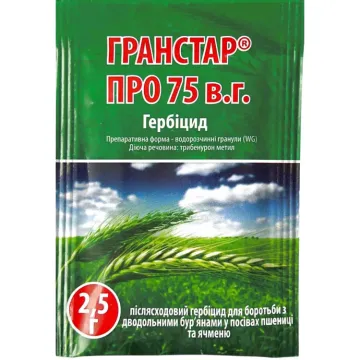
Granstar Pro 75
«Дюпон Інтернешнл Оперейшнз Сарл», Швейцарія
Herbicides, Desiccants
0
0
·
51
1 offer
86 €за 1 л
Купить

Narrow-leaved pepperwort (Lepidium ruderale) belongs to the Brassicaceae family. According to biological classification, it is an annual or wintering herbaceous plant characterized by high adaptability to various environmental conditions, including compacted and saline soils.
This species is widely distributed throughout Eurasia. It is a typical ruderal plant often found along roadsides, on waste grounds, construction sites, and landfills. In agricultural production, it causes damage to perennial grass crops, grain crops, row crops, and is frequently encountered in vegetable gardens and pastures.
The biology of the plant ensures its high survival rate. It reproduces exclusively by seeds. Flowering occurs from May to June, and seed ripening takes place from July to August. A single plant can produce a significant amount of seeds (up to 10,000–15,000), which remain viable in the soil for several years, making the eradication of the population difficult.
The harm caused by narrow-leaved pepperwort lies in its ability to quickly colonize open areas, displacing cultivated plants. It competes for moisture, nutrients, and sunlight, especially during the early stages of crop development. Furthermore, this weed can serve as an intermediate host for several pests and pathogens typical of cruciferous crops.
An integrated approach is used for effective control:
Taxonomy and Latin: EPPO Global Database · code LEPRU
