
Raisin Kishmish – Benefits of Berries
When it comes to berries and fruits, it's hard to believe these products could be harmful at first glance. Vitamins, fructose, fiber — what harm could there be? Pure benefit! But it's not that simple.
When it comes to berries and fruits, it's hard to believe these products could be harmful at first glance. Vitamins, fructose, fiber — what harm could there be? Pure benefit! But it's not that simple.
Kishmish grape - is one of the most popular grape varieties. The main reason housewives prefer this variety over others is the absence of seeds, which is undoubtedly convenient, and for small children — even safer.
Regarding taste qualities, kishmish berries have a light but distinctive flavor of nutmeg and fruit — similar to some white wines.
Health Benefits
Moreover, kishmish is very sweet — approximately 400 kcal per 100 grams of grape. In Arabic, the name of this variety literally translates as "dried berries," or, as we are accustomed to, raisins. There is the most sugar in such grapes, but there are also plenty of vitamins — A, C, B1, B2, B5, PP. There are also many trace elements — potassium, magnesium, iron, phosphorus, chromium. It's no wonder that in Asia it is commonly used as a medicine.
Also, kishmish contains oleanolic acid. It acts as a kind of disinfectant for mucous membranes of the body, particularly the mouth. Thus, consuming grapes serves as a preventive measure against gum disease, cavities, even rotavirus.
Despite its thin skin, which pleasantly bursts in the mouth, kishmish is quite resistant to frost as well as to heat on its native soil. After ripening, it can remain for about a month without chemical treatment, while being insensitive to fungal diseases. Of course, under certain temperature conditions. It varies depending on the variety. Previously, we spoke about green kishmish. The rest — further.
Black Kishmish
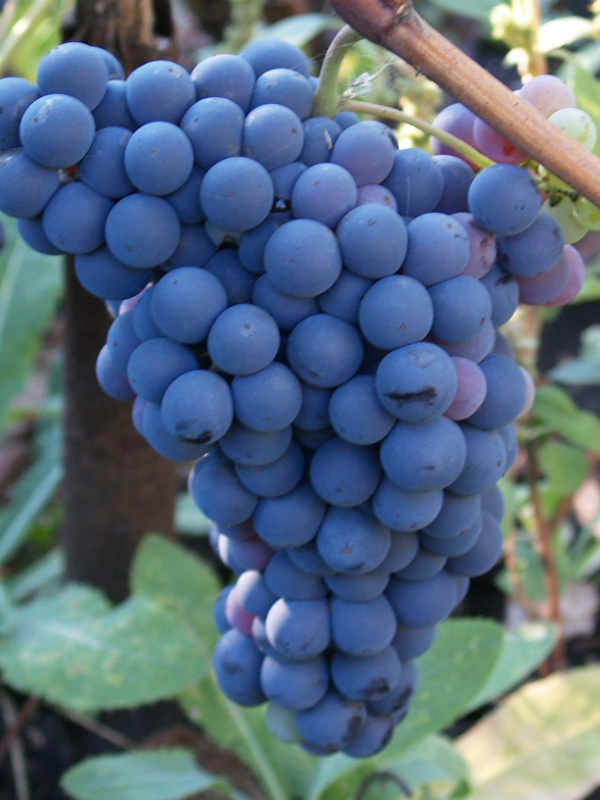
Some may be surprised that kishmish is not only light-salad colored. Round berries with a cloudy blue color, with a characteristic grape-like bloom — this is black kishmish. Its skin is slightly tougher than green, and it has a mild astringent effect, like any dark grape. It is sweeter than green. It has two unique compositional features. First — the presence of folic acid, beneficial for women preparing for pregnancy or already pregnant. Second — a set of essential oils, beneficial for people with low blood pressure. Also, consumption of this grape variety improves digestion due to iron salts, prevents aging, anemia, and nervous exhaustion due to the presence of quercetins. It also improves immunity and tissue regeneration, tones the body, and strengthens the heart muscle. However, the latter is characteristic of all dark grape varieties with regular consumption.
Primorsky Kishmish
This is, strictly speaking, not a grape at all. Primorsky kishmish refers to actinidia, belonging to the liana family. Just as peanuts are called nuts, although they belong to legumes, there is the same confusion with "Primorsky grape".
Berries are large, with a rich green color and matte skin. They have seeds. When cut open, they resemble a miniature version of kiwi. Berries are rich in vitamin A.
Growing kishmish is very easy. It is undemanding and frost-resistant. There are varieties where clusters can weigh three to four kilograms.
Even a beginner gardener can manage this crop.
Editorial team agronom.info
Materials are prepared by the portal's agronomists and editors. We use only trusted sources: Ukrainian agricultural universities, variety registries, open scientific publications.


Comments · 0