Monkey puzzle tree
Araucaria araucana (Molina) K. Koch
Description
The monkey puzzle tree (Araucaria araucana) is a long-lived evergreen conifer belonging to the Araucariaceae family. Often referred to as a living fossil, this species has survived from the Mesozoic era, making it one of the most botanically significant trees in the world.
Native to the lower slopes of the southern Chilean and Argentinean Andes, the tree thrives in temperate maritime climates. Its natural range is characterized by volcanic soils and high precipitation, which are key factors to consider when attempting to cultivate the species in non-native environments.
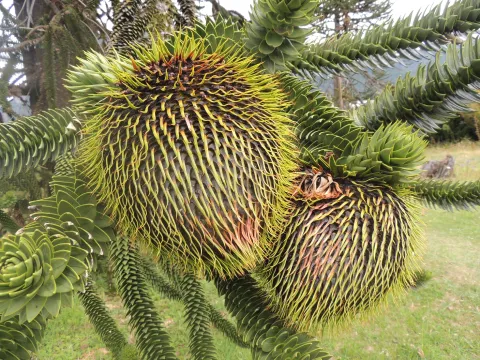
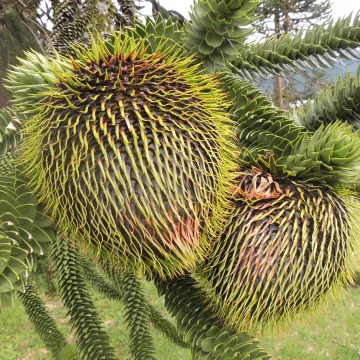
Botanically, the tree is distinguished by its thick, sharp, triangular leaves arranged spirally around the branches, and its heavy, woody cones. It is dioecious, meaning male and female cones are typically produced on separate trees, which is a critical consideration for those interested in seed production.
In terms of silviculture, the tree requires well-drained, slightly acidic soil and a site with consistent moisture. It is not drought-tolerant and performs poorly in areas with intense, scorching summer heat. Propagation is primarily done through seeds, which should be planted as soon as possible after harvesting to ensure viability.
The tree serves several хозяйственные purposes, ranging from the extraction of protein-rich seeds, known as piñones, to high-value timber production. Pathogens and pests such as root rot fungi and certain scale insects can be problematic, necessitating strict adherence to irrigation schedules and periodic health inspections.
Photo gallery