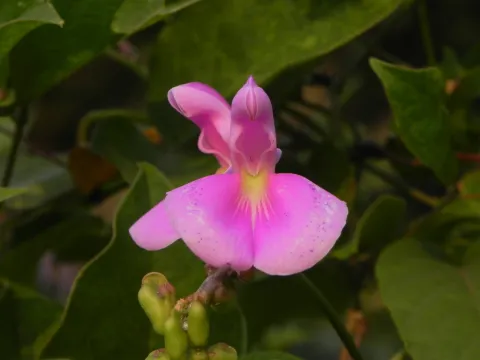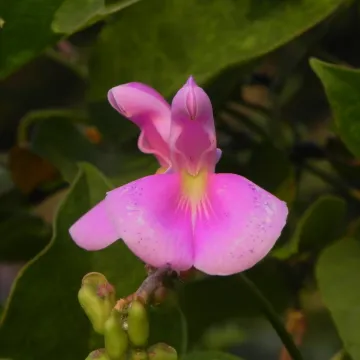

Sword bean
Canavalia gladiata (Jacq.) DC.
Description
Sword bean (Canavalia gladiata) is a vigorous, climbing herbaceous plant belonging to the Fabaceae family. It is widely recognized for its distinctive, large, sword-shaped pods that can reach lengths of up to 40 centimeters. As a hardy legume, it is well-adapted to tropical and subtropical environments, serving as both a food source and a beneficial cover crop.
Originating from tropical Asia, the sword bean has become a staple in many tropical countries across Africa and the Americas. It is known for its ability to thrive in a variety of soils, provided there is adequate sunlight and warmth. Its wide distribution is a testament to its ecological adaptability and its importance in traditional farming systems across the equatorial belt.
Regarding climate and soil, the sword bean is strictly a warm-weather crop. It requires consistent temperatures and is highly sensitive to frost. While it can tolerate a range of soil types, it performs best in well-drained, fertile loam. Its drought tolerance is relatively high compared to other beans, making it a reliable secondary crop in regions with unpredictable rainfall patterns.
Agrotechnical practices for the sword bean focus on vertical support. As a climbing plant, it requires stakes or trellises to maximize pod production and ensure air circulation, which prevents fungal issues. The crop is often planted in intercropping systems, where it fixes atmospheric nitrogen through root nodulation, thereby improving the fertility of the surrounding soil for subsequent crops.
The economic value of the sword bean is multifaceted. The immature pods are harvested and eaten as vegetables, providing essential minerals and fiber. Mature seeds are processed and consumed after proper preparation to neutralize antinutritional factors. Furthermore, the foliage is highly valued as a high-protein fodder for livestock, and the entire plant acts as an excellent soil stabilizer against erosion.
Typical challenges for the cultivation of sword bean include:
- Insects such as leaf miners and bean beetles (Bruchidae).
- Root rot diseases in waterlogged or poorly drained soils.
- Bacterial wilt, which can affect foliage density in high-humidity areas.
- Aphid infestations that may lead to secondary viral infections.
Photo gallery