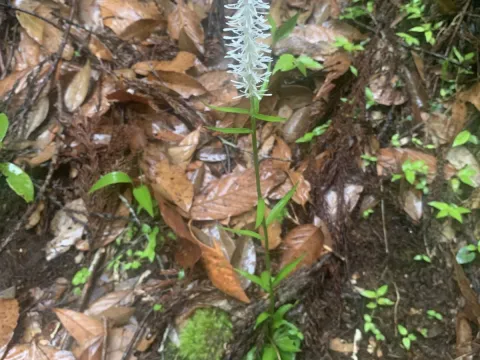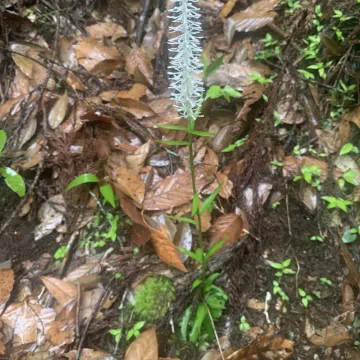
Japanese fairy wand
Chamaelirium japonicum
Description
The Japanese fairy wand (Chamaelirium japonicum) is a herbaceous perennial plant belonging to the Melanthiaceae family. It is a distinctive botanical species known for its graceful appearance, featuring a basal rosette of leaves and a slender, upright spike of small, whitish flowers. As a cultivated crop, it is highly appreciated in niche horticulture for its architectural elegance and unique seasonal display.
Originating from East Asia, including Japan, Korea, and China, the plant typically inhabits moist deciduous forests and shaded slopes. This geographical background dictates its ecological requirements. In cultivation, it thrives in environments that replicate the humid, temperate conditions of its native woodland habitat, requiring protection from extreme heat and desiccating winds.
Botanically, the plant develops from a sturdy, short rhizome. Its leaves are generally lanceolate or spatulate, forming a tidy rosette at the soil level. The inflorescence, rising in late spring or early summer, carries a dense or sometimes elongated raceme of flowers. These reproductive organs are specifically adapted to attract local pollinators within their native ecosystem, ensuring the species' survival.
Regarding agrotechnical requirements, the soil must be rich in organic matter, slightly acidic to neutral, and well-drained. Proper soil structure is critical; the medium should retain moisture without becoming waterlogged. Growing the plant in filtered sunlight or partial shade is essential, as direct midday sun can damage the foliage and cause severe dehydration during the growth cycle.
The primary use of the Japanese fairy wand is ornamental, serving as a focal point in shade-loving plant collections. While its medical properties are a subject of secondary interest due to saponin content, the main focus remains on its cultivation as a high-value ornamental crop. Potential threats include root rot under excessive humidity and damage from slugs or snails, which can be mitigated through good cultural practices and regular observation.
- Family: Melanthiaceae.
- Hardiness: Adapted to temperate woodland conditions.
- Blooming season: Late spring to early summer.
- Primary threat: Excessive soil moisture causing root decay.
Photo gallery