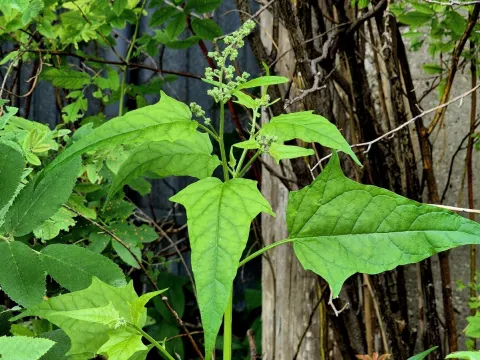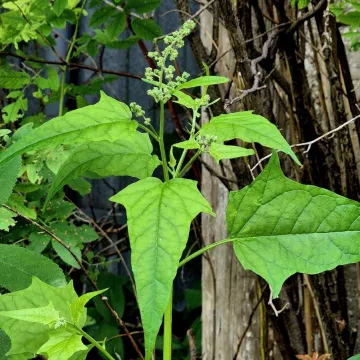
Maple-leaved goosefoot
Chenopodiastrum hybridum
Description
Maple-leaved goosefoot (Chenopodiastrum hybridum) is an annual herb belonging to the Amaranthaceae family. Previously classified under the genus Chenopodium, it has been reclassified into the distinct genus Chenopodiastrum. This plant is well-known in agricultural circles as a persistent weed that thrives in nutrient-rich soils.
The species is widely distributed across the temperate regions of Eurasia. It commonly colonizes disturbed habitats such as arable land, gardens, and waste areas. Its ability to colonize various soil types, particularly those rich in nitrogen and organic matter, makes it a significant competitor for resources in commercial cropping systems.
Botanically, the plant is distinguished by its distinct maple-like leaves with large, sharp, triangular teeth. The stem can reach up to one meter in height, typically displaying an upright growth habit. The flowers are small, greenish, and clustered in panicles, blooming from mid-to-late summer, eventually producing a high volume of small, dark seeds.
Agronomic control of this species requires a combination of mechanical and cultural practices. Regular tillage, crop rotation, and precise nutrient management are essential to limit its density. Because the seeds can remain dormant in the soil, integrated pest management strategies are often necessary to reduce the seed bank over multiple growing seasons.
While primarily considered a weed, it is biologically sensitive to several pathogens, including downy mildew and various leaf spot fungi. Its presence in fields can signal high soil fertility, but it also warrants monitoring for potential pest transmission.
- Mechanical cultivation of inter-rows
- Strict adherence to crop rotation cycles
- Judicious use of pre-emergent herbicides
Photo gallery