Red cinchona
Cinchona pubescens Vahl
Description
Red cinchona (Cinchona pubescens Vahl) is an evergreen tree species belonging to the Rubiaceae family. Historically significant, this plant is well-known for its bark, which contains alkaloids that revolutionized the treatment of malaria. As an agricultural crop, it requires specific management to optimize the concentration of these valuable compounds.
The native range of this species extends across the Andean regions of South and Central America, spanning from Costa Rica to Peru. Following its discovery by Europeans, it was introduced to various tropical regions worldwide, including parts of Africa and Southeast Asia, where it has successfully naturalized and is grown in plantation settings for industrial extraction.
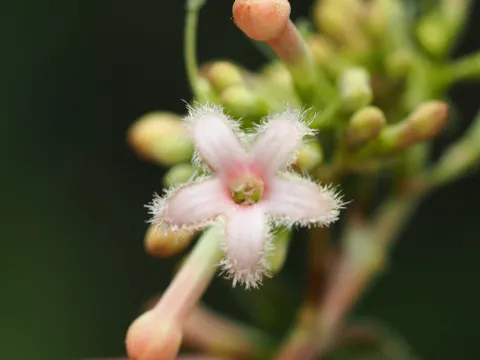
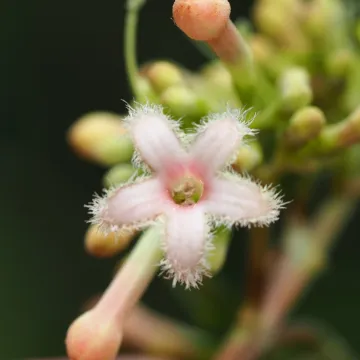
Botanically, Cinchona pubescens is characterized by its large, opposite leaves and terminal panicles of fragrant, reddish or pinkish flowers. It can reach a considerable height in its natural habitat. The fruit is a septicidal capsule that releases numerous winged seeds, facilitating rapid dispersion, which contributes to its status as a highly successful invader in some environments.
The cultivation of red cinchona requires a tropical climate with consistent warmth and high humidity levels throughout the year. It performs best on deep, well-draining, and nutrient-rich soils. Successful agronomy involves careful site selection, as the plant does not tolerate frost or waterlogged soil conditions, which can lead to root pathogens and stunted development.
In terms of economic utility, the bark remains the primary product, harvested for its medicinal alkaloids, including quinine, cinchonine, and cinchonidine. Beyond its pharmaceutical value, the plant is sometimes managed in agroforestry systems. However, due to its invasive nature, farmers must manage populations carefully to prevent them from encroaching into native forests and displacing indigenous plant species.
- Prefers high-altitude tropical environments.
- Sensitive to nutrient deficiencies in early stages.
- Requires protection from intense, direct sunlight when young.
- Harvesting bark requires sustainable methods to ensure tree survival.
Photo gallery