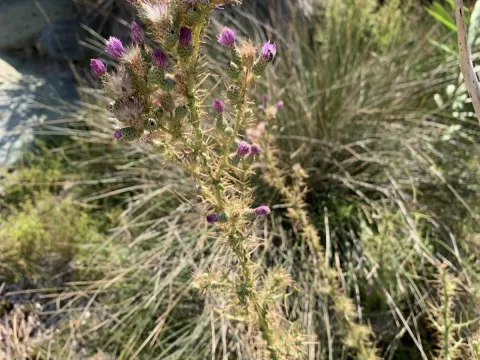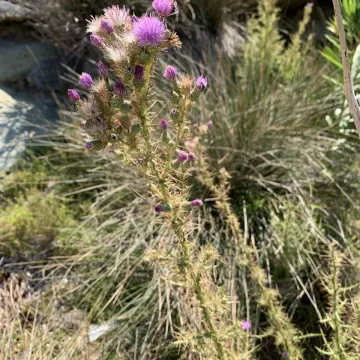
Cretan thistle
Cirsium creticum
Description
Cretan thistle (Cirsium creticum) is a perennial herbaceous plant belonging to the Asteraceae family. While it is often managed as a weed in agricultural landscapes, it remains a significant botanical specimen within its native Mediterranean range, providing specific ecological functions in wetlands and meadows.
Originating from the Mediterranean region, including Crete and the Balkan Peninsula, this species has adapted to diverse landscapes. It typically colonizes areas with high moisture levels, such as riverbanks, marshy meadows, and low-lying terrains. Its ability to propagate effectively in these environments makes it a resilient competitor against other vegetation.
Botanical characteristics include a tall, erect stem often reaching 1.5 meters, accompanied by spiny, serrated leaves that serve as a defense mechanism. The plant produces vibrant pink to purple flower heads, which are hallmark traits of the Cirsium genus. The root system is deep and expansive, allowing the plant to persist through seasonal fluctuations in environmental conditions.
In terms of agricultural management, Cirsium creticum requires fertile, damp soil to thrive. Agronomists focus on preventive strategies such as deep tillage to disrupt the rootstock, as well as mechanical mowing before seed set to limit expansion. In protected areas or ecological zones, management might be less intensive, allowing it to serve as a niche plant for biodiversity.
Economically, the Cretan thistle is recognized for its nectar production, making it a valuable resource for pollinators, including bees and butterflies. Despite its utility to insects, its presence in arable fields is generally discouraged, as it can compete with crops for nutrients and sunlight, necessitating integrated weed management practices to protect yields.
- Scientific classification: Asteraceae.
- Native habitat: Mediterranean wetlands.
- Growth habit: Perennial, tall-growing.
- Management: Deep cultivation and mechanical removal.
Photo gallery