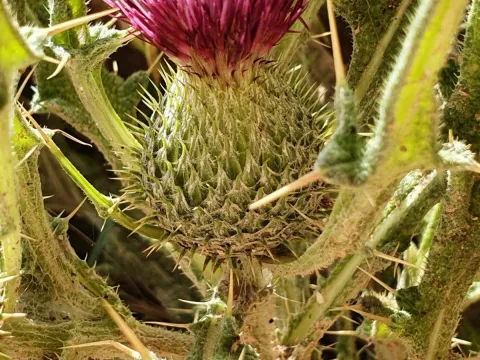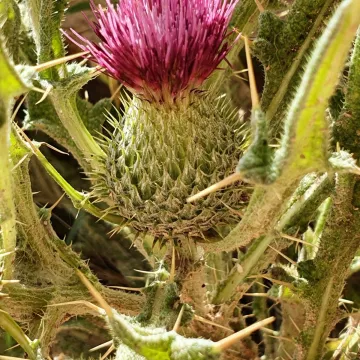
Bristly thistle
Cirsium echinatum
Description
Bristly thistle (Cirsium echinatum) is a perennial herbaceous plant belonging to the Asteraceae family. It is recognized for its adaptive capacity to colonize various habitats, often functioning as a persistent weed that poses challenges to agricultural productivity in regions where it establishes.
The origin and natural distribution of Cirsium echinatum are predominantly found in the Mediterranean basin and parts of Southern Europe. It thrives in open, sunny environments, dry meadows, and rocky slopes. In agricultural settings, it is classified as a competitor that exploits nutrient-rich soils, potentially reducing the yield of primary crops.
Botanically, the species is characterized by a strong taproot system and spiny foliage, which serves as a defense mechanism against herbivores. The stem is rigid and ribbed, supporting globular flower heads protected by sharp, echinate bracts. This structure ensures that the reproductive organs are shielded during the development phase.
Effective management requires a deep understanding of its physiological cycles. Because the plant is resilient to physical disturbances, agronomists recommend integrated weed management (IWM) strategies. Key practices include:
- Strategic plowing to disrupt root reserves.
- Application of selective herbicides during the early rosette stage.
- Maintaining competitive crop density to shade out young seedlings.
From an agricultural standpoint, Cirsium echinatum is primarily managed as a pest, though it supports biodiversity by providing nectar for pollinators such as bees and butterflies. Typical diseases affecting the plant include various rust fungi that can infect the leaves, while stem-boring insects act as natural biological suppressors in native populations.
Photo gallery