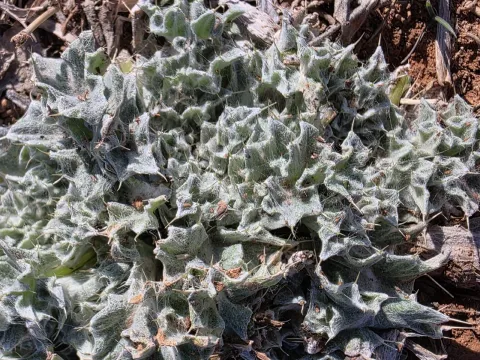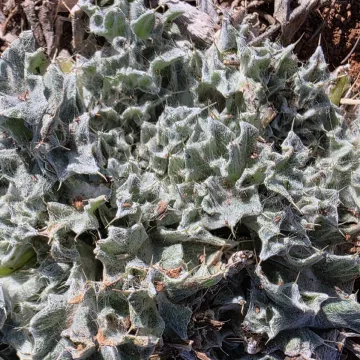
Wavy-leaf thistle
Cirsium undulatum
Description
The wavy-leaf thistle (Latin: Cirsium undulatum) is a perennial herbaceous plant belonging to the Asteraceae family. In agricultural settings, it is primarily recognized as a persistent weed that poses significant challenges for crop management due to its robust growth habits and ability to compete with cultivated plants.
Native to North America, the plant is typically found in prairies, plains, and disturbed open areas. It has successfully adapted to diverse environments, demonstrating a high degree of resilience in drought-prone regions where it utilizes its extensive root system to access water deep within the soil, giving it a competitive advantage over many shallow-rooted crops.
Botanically, it is characterized by its stiff, leafy stems covered with fine hairs, which can reach up to one meter in height. The foliage features distinctive wavy, serrated edges with sharp spines. The flower heads are large and typically rose-purple, blooming from late spring to summer, which attracts diverse pollinators, making it an ecologically significant but agriculturally troublesome species.
The plant requires well-drained soils and full sun exposure to thrive. From an agrotechnical perspective, management is difficult because of the plant's ability to regenerate from fragmented rhizomes. Effective control strategies usually necessitate a combination of mechanical disruption and chemical interventions, as single-pass operations are often insufficient to eliminate established colonies.
- Deep taproot system for efficient water uptake.
- High competitive ability in field crops.
- Resistance to various environmental stressors.
- Significant nectar production for pollinators.
While often viewed solely as a nuisance, the wavy-leaf thistle plays a role in the local ecosystem by providing resources for insects. In managed agricultural systems, the focus remains on preventing its expansion into productive lands. Integrated pest management, including crop rotation and the maintenance of soil fertility, is essential for mitigating its spread.
Photo gallery