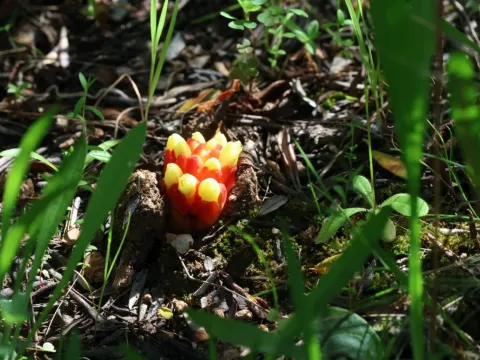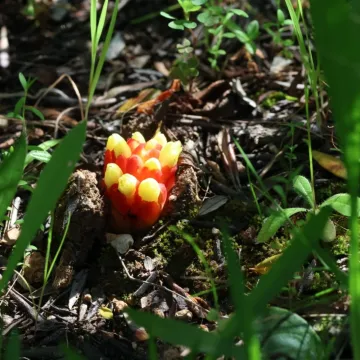
Cytinus hypocistis
Cytinus hypocistis
Description
Cytinus hypocistis is a remarkable chlorophyll-lacking parasitic plant belonging to the family Cytinaceae. Unlike conventional crops, this plant functions as an obligate root parasite, extracting water and nutrients directly from the roots of its host, typically shrubs from the Cistus genus.
The origin of this species is linked to the Mediterranean Basin. Its natural distribution range covers Southern Europe, Northern Africa, and parts of the Middle East. Because it relies entirely on a host plant, it cannot be cultivated in standard agricultural settings and thrives only in stable, natural shrubland ecosystems.
Botanically, Cytinus hypocistis remains hidden underground for most of its life, manifesting only during the flowering stage. It produces fleshy, scale-covered stems topped with vibrant yellow to reddish-orange inflorescences. Since it lacks chlorophyll, it does not perform photosynthesis and must draw all organic matter from the host plant's vascular system.
The climatic requirements for this plant are defined by the needs of its host, the Cistus. It prefers the Mediterranean climate, characterized by dry, hot summers and mild, wet winters. The soil must be well-drained and rocky or sandy. Agricultural practices do not apply to this species, as it is an integral component of wild biodiversity rather than a crop for commercial farming.
Historically, the plant has been used in folk medicine for its astringent properties. Economically, it has little significance beyond local ethnomedical or botanical interest. In terms of plant health, it is not subject to traditional pests or diseases, as it occupies a specialized ecological niche that protects it from many common threats faced by standard crops.
Photo gallery