Dragon tree
Dracaena draco (L.) L.
Description
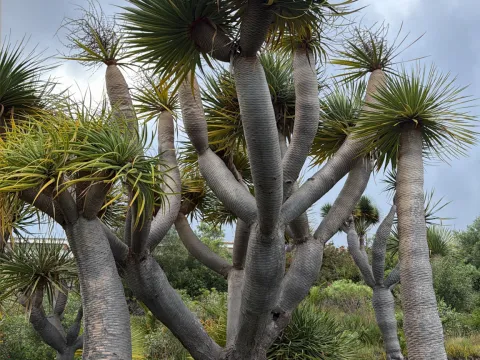
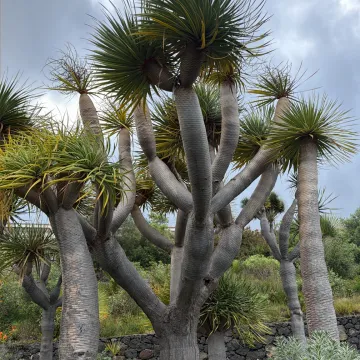
The Dragon tree (Dracaena draco) is a succulent, tree-like plant belonging to the Asparagaceae family. It is widely recognized for its architectural form, consisting of a stout, branching trunk topped with stiff, sword-shaped leaves that form a dense, umbrella-shaped canopy.
Native to the Canary Islands, Cape Verde, Madeira, and parts of western Morocco, the Dragon tree thrives in semi-arid environments. It is adapted to rocky, well-drained soils and is historically significant for the red resin exuded from its trunk, often referred to as dragon's blood, which has been used throughout history as a dye and medicinal ingredient.
Botanically, it is a slow-growing species that can reach significant heights over many decades. The plant develops unique secondary growth in the stem, which distinguishes it from many other monocots. Its inflorescences consist of small, greenish-white flowers that eventually yield orange-red berries upon successful pollination.
Agricultural requirements for Dracaena draco focus on excellent drainage and sunlight exposure. The species is highly drought-tolerant once established but requires consistent, albeit low, irrigation to maintain health. Soil should be sandy or loamy with a slightly alkaline or neutral pH, mimicking its natural habitat on cliffsides and dry hills.
Management of the crop requires vigilance regarding specific biological threats:
- Spider mites and mealybugs, which are common in low-humidity environments.
- Root rot, resulting from poor soil drainage or over-watering in cool climates.
- Fungal leaf spot diseases that thrive in stagnant air and high-humidity scenarios.
Photo gallery