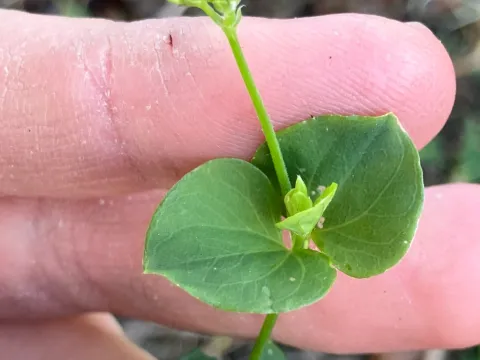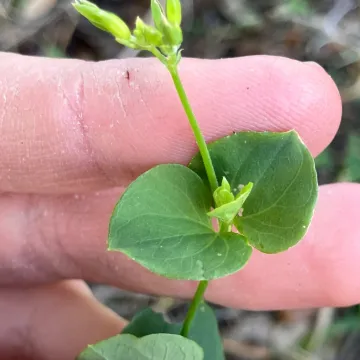
Drymaria cordata
Drymaria cordata (L.) Willd. ex Schult.
Description
Drymaria cordata, commonly known as tropical chickweed, is an herbaceous plant belonging to the Caryophyllaceae family. It is widely recognized in tropical and subtropical regions for its vigorous growth and rapid colonization abilities, functioning either as a beneficial ground cover or, depending on the agricultural context, as an invasive weed in various farming systems.
The plant is native to the tropical regions of the Americas, but it has spread extensively across Asia, Africa, and the Pacific Islands. It thrives in moist, shaded, and disturbed habitats, such as riparian zones, forest clearings, coffee plantations, and moist agricultural fields. Its ability to adapt to diverse soil types, including sandy and loamy textures, allows it to persist in varying environmental conditions.
Botanically, Drymaria cordata is characterized by its prostrate or ascending stems, which often root at the nodes when in contact with moist soil. The leaves are distinctively cordate (heart-shaped) and arranged in an opposite pattern. The plant produces small, white, ephemeral flowers that develop into capsules containing tiny seeds, facilitating both generative and vegetative propagation.
In terms of cultivation, it requires consistent moisture and moderate shade to achieve optimal biomass production. The species is sensitive to prolonged drought and frost, preferring fertile, well-draining soils with adequate organic matter content. Agronomic management involves monitoring its spread, as its aggressive growth habit can lead to competition with main crops if not properly managed.
The economic and practical utility of Drymaria cordata is significant in traditional medicine, where it is utilized for its anti-inflammatory, analgesic, and antitussive properties. Furthermore, in regenerative agriculture, it is sometimes utilized as a living mulch or ground cover to suppress soil erosion, conserve moisture, and enhance soil health in humid environments where competition with primary crops is minimized.
Photo gallery