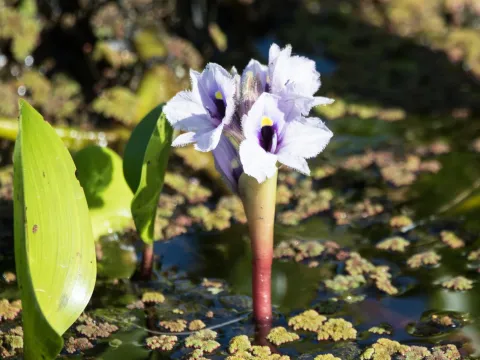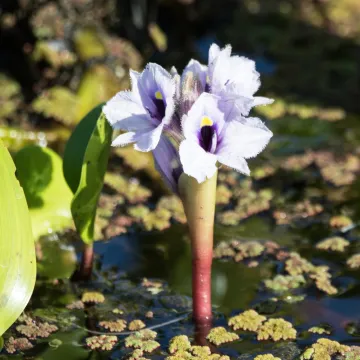
Anchored water hyacinth
Eichhornia azurea (Sw.) Kunth
Description
The anchored water hyacinth (Eichhornia azurea) is a perennial aquatic plant belonging to the Pontederiaceae family. Unlike other species in the genus that are strictly free-floating, this plant is primarily known for its ability to anchor itself to the substrate, making it a distinct and valuable specimen for water gardens and high-end aquascaping projects.
Native to tropical South and Central America, Eichhornia azurea thrives in slow-moving or stagnant freshwater habitats. It is prominently found throughout the Amazon basin. In these regions, it contributes significantly to the health of aquatic environments by providing shelter for micro-fauna and absorbing excess nutrients, which helps maintain water quality.
The botany of the plant is defined by its dramatic leaf dimorphism. Submerged leaves are narrow and lanceolate, adapted to flowing water conditions, while aerial leaves are broad, leathery, and heart-shaped. The stem is elongate and flexible, capable of reaching several feet in length, with nodes that sprout dense root systems that extract essential minerals directly from the water column and substrate.
To successfully cultivate this species, growers must provide intense lighting and a consistent tropical temperature range between 22°C and 30°C. It performs best in nutrient-rich water. Because of its rapid growth rate, regular pruning is necessary to prevent the plant from dominating the space and shading out competing vegetation, particularly in smaller aquatic containers.
Economically, the plant is valued for its ornamental appeal and its function in phytoremediation. While its growth is easily managed in controlled environments, it is classified as a potential weed in some tropical climates where it can aggressively colonize waterways. Disease and pest management typically involve preventing algal blooms that compete for light and maintaining balanced water chemistry to prevent nutrient deficiency-related chlorosis.
- Temperature requirements: 22–28°C.
- Light intensity: High, requiring full-spectrum aquatic lamps.
- Substrate: Deep, nutrient-rich soil is preferred.
- Maintenance: Regular trimming and micronutrient dosing.
Photo gallery