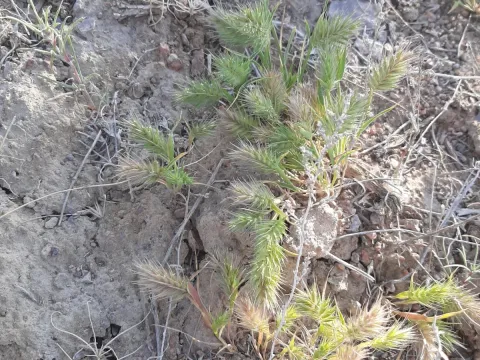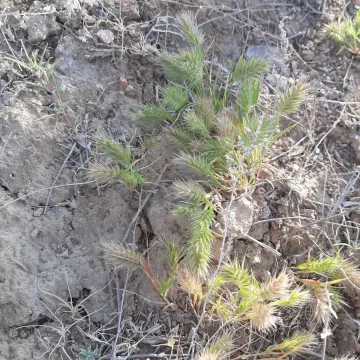
Eremopyrum distans
Eremopyrum distans
Description
Eremopyrum distans is an annual grass species belonging to the Poaceae family. Known for its remarkable resilience in arid and semi-arid environments, this plant serves as a vital component of natural steppe ecosystems. It is characterized by its ability to thrive in challenging soil conditions, including saline and alkaline sites where other vegetation may struggle to establish.
The origin of Eremopyrum distans is linked to the Eurasian steppe zones, stretching from Eastern Europe to Central Asia. Its natural range includes dry rocky slopes and salt-affected areas. As a specialized forage grass, it has been historically recognized for its utility in grazing systems located in regions with low and erratic annual precipitation.
Botanically, the species is defined by its small, compact structure, reaching heights typically between 10 and 30 centimeters. Its inflorescence is a spike with distinct, spaced-out spikelets, which gives the plant its diagnostic appearance. The shallow, fibrous root system is highly efficient at capturing early-season moisture before the heat of summer sets in.
Agricultural management for Eremopyrum distans is straightforward due to its adaptation to harsh conditions. When integrated into pasture management, the following aspects are critical:
- Early spring sowing to capitalize on soil moisture availability.
- Avoidance of nutrient-rich, overly moist soils which might decrease its competitive edge.
- Minimal tillage to protect soil integrity in fragile ecosystems.
In terms of хозяйственное использование (хозяйственное использование), the crop is primarily valued for its early spring grazing potential. Livestock forage on the young growth, which is nutritious and helps bridge the gap in feed supply before late-season grasses become available. Its ability to tolerate moderate grazing pressure makes it a reliable pasture component.
Regarding health management, Eremopyrum distans can be susceptible to rust fungi when seasonal conditions provide excessive humidity. Furthermore, seed-feeding insects may occasionally impact yield in seed production areas. However, because the plant is well-adapted to its native environmental niches, severe outbreaks are rare under proper rangeland management practices.
Photo gallery