
Mediterranean spurge
Euphorbia characias L.
Description
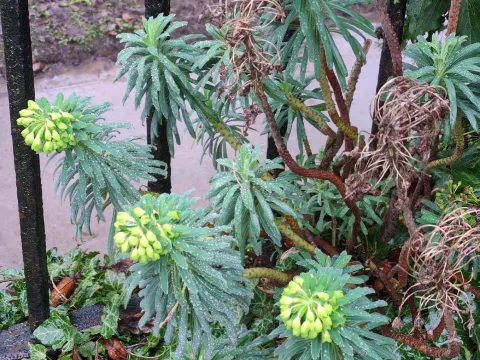
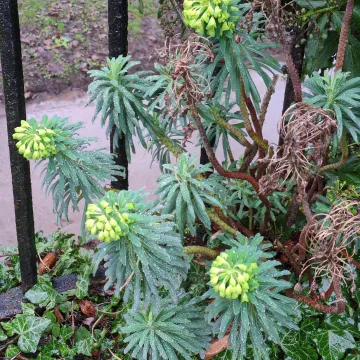
Mediterranean spurge (Euphorbia characias L.) is a robust, evergreen perennial shrub belonging to the Euphorbiaceae family. It is widely recognized for its sculptural appearance, dense foliage, and striking chartreuse flower heads that provide interest in the garden during late winter and spring.
The plant originates from the Mediterranean region, where it thrives in rocky, well-drained soils and open, sunny environments. Its native habitat has made it a model for xeriscaping, as it is highly adapted to arid conditions and warm climates, though it can survive in sheltered spots in cooler temperate zones.
Botanically, it forms a rounded, multi-stemmed bush reaching up to 120 cm in height. The stems are densely packed with narrow, grey-green leaves. The inflorescences are distinct cylindrical racemes of small flowers, surrounded by showy, yellow-green bracts. These bracts persist for several months, making the plant a focal point long after flowering begins.
Regarding cultivation, Mediterranean spurge requires full sun and exceptionally well-draining, poor-to-moderate soil. It is particularly susceptible to root rot if soil remains damp, especially in winter. Minimal maintenance is required: gardeners should prune back flowered stems to the ground in summer to encourage new growth and keep the plant compact.
In terms of usage, it is an excellent choice for rock gardens, mediterranean-style borders, and pots. Due to its milky sap, which is irritating to skin and toxic if ingested, it is rarely bothered by pests or diseases, though care must be taken when pruning. Always wear gloves to protect against the plant's natural chemical defense.
- Excellent drought tolerance.
- Requires minimal fertilization.
- Best propagated by semi-ripe cuttings.
- Resistant to most common garden pests.
Photo gallery