
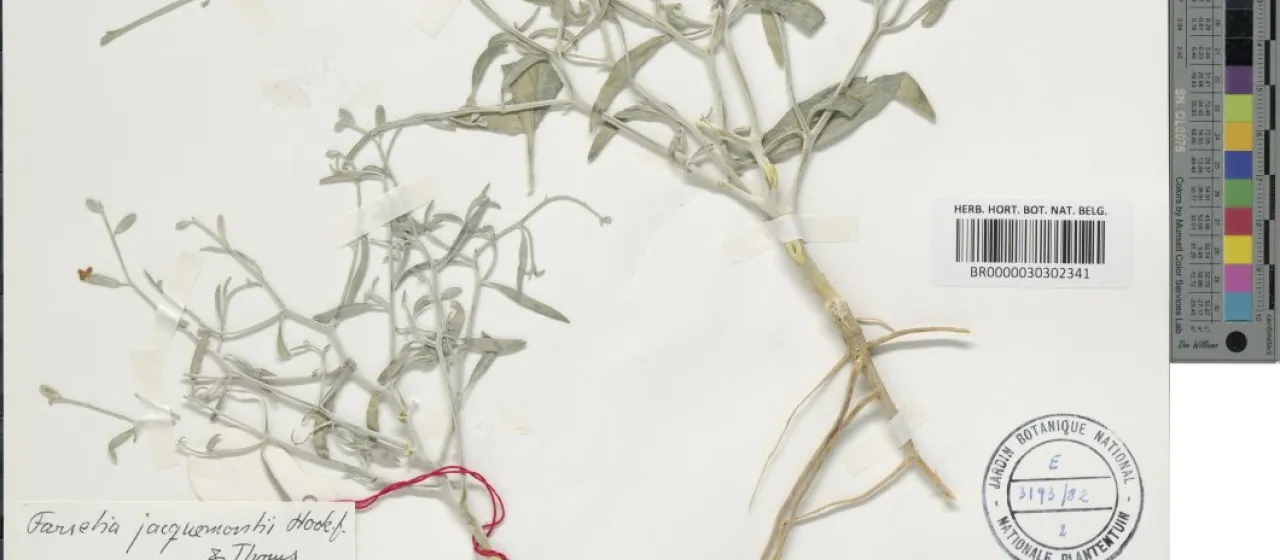
Description
Farsetia jacquemontii is a perennial herb belonging to the Brassicaceae family, recognized for its exceptional resilience in arid and semi-arid climates. As a specialized agricultural candidate, it represents a unique group of plants adapted to survive in extreme desert environments where water scarcity prevents the cultivation of conventional food crops.
The origin of this species is traced back to the arid tracts of Western Asia, specifically covering regions in Pakistan and India. Its distribution is naturally concentrated in sandy plains, gravelly habitats, and rocky slopes, where it plays an ecological role in stabilizing soil and maintaining biodiversity under harsh environmental pressures.
Botanically, Farsetia jacquemontii is a subshrub with a woody base and greyish, pubescent foliage. This dense hair covering serves as a critical adaptation to minimize transpiration and protect the plant tissue from intense solar radiation. The plant produces typical cruciferous flowers, leading to the formation of seed pods that contain valuable oil reserves.
Regarding cultivation, the agronomy of this species focuses on low-input management systems. It thrives in well-drained, sandy soils and requires minimal moisture once the plants are established. Farmers or researchers working with this species must focus on optimal sowing depth and timing to ensure germination during the limited rainy periods characteristic of their habitat.
In terms of economic application, Farsetia jacquemontii is viewed as an emerging source of vegetable oil and a vital component for restoring degraded drylands. Furthermore, its ability to produce biomass in infertile conditions makes it a potential forage crop for livestock in regions where food security depends on utilizing marginal, water-stressed agricultural lands.
- Extreme drought and heat tolerance.
- Adaptability to nutrient-poor and saline soil types.
- Potential as a non-food oilseed crop.
- Low requirement for irrigation or synthetic inputs.