
Description
Thurber's cotton (Latin: Gossypium thurberi) is a wild species of flowering plant within the mallow family (Malvaceae). Unlike its domesticated relatives that provide the world's cotton fiber, this species is primarily valued as a genetic reservoir for agricultural research rather than a commercial source of textile materials.
The plant originates from the arid regions of southwestern North America, specifically Arizona in the United States and various parts of Mexico. It typically thrives in desert washes, rocky canyons, and mountain slopes where conditions are harsh, characterized by significant drought and intense solar radiation, to which the plant has developed remarkable physiological adaptations.
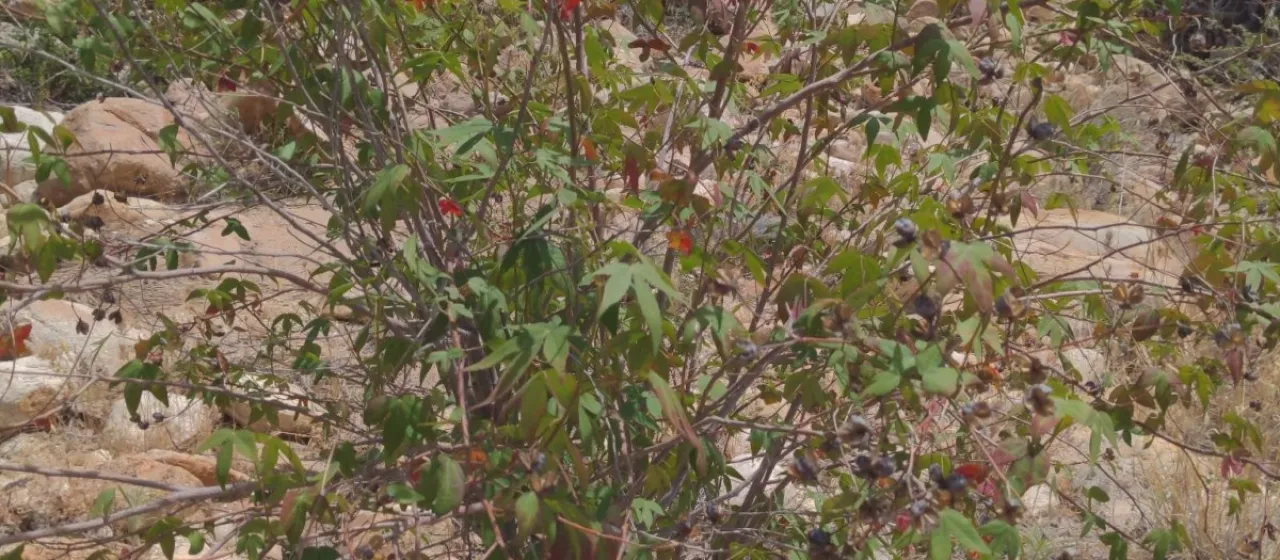
Botanically, Gossypium thurberi is a perennial shrub that can grow up to three meters tall. It features palmately lobed leaves and delicate, small flowers that range from white to purplish hues. Its fruit is a small capsule containing seeds covered in very short, non-spinnable lint, which makes the plant useless for conventional cotton fiber production.
Cultivation requirements for this species are strict. It demands high thermal units for growth, well-aerated sandy or gravelly soils, and very low humidity. It is extremely sensitive to waterlogging, as its roots are adapted to rapid drainage. In research settings, it is often kept in controlled greenhouse environments to study its tolerance to extreme environmental stressors.
The primary agricultural use of Thurber's cotton lies in its role in interspecific hybridization. It is prized by breeders for its natural resistance to certain pests and pathogens, attributed to its high gossypol content. By crossing Gossypium thurberi with commercial cotton, scientists develop modern, resilient cultivars that require fewer chemical inputs for pest control.