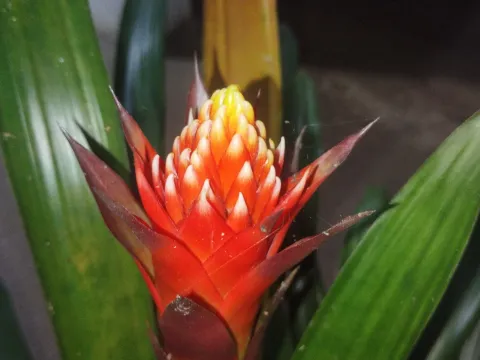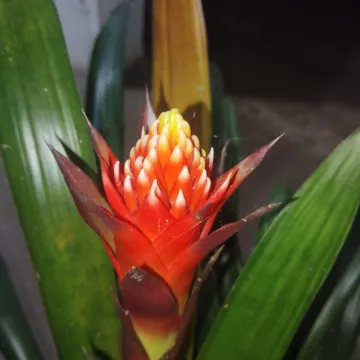
Guzmania conifera x Guzmania lingulata
Guzmania conifera x Guzmania lingulata
Description
Guzmania (Guzmania conifera x Guzmania lingulata) is a specialized hybrid belonging to the Bromeliad family (Bromeliaceae). This ornamental crop is widely appreciated for its architectural foliage and striking inflorescence, which inherits the distinctive cone shape of the conifera parent and the vibrant bracts of the lingulata parent.
The plant originates from the tropical rainforests of Central and South America. In its natural habitat, it acts as an epiphyte, growing on tree trunks or rock crevices. This evolutionary background dictates its unique biology: the roots function primarily for anchorage, while the central rosette serves as the primary reservoir for water and nutrient absorption from the air and rain.
Botanically, the plant features a dense basal rosette of leathery, strap-shaped leaves. The inflorescence emerges from the center of the rosette on a sturdy scape. This hybrid displays a monocarpic habit, meaning the parent plant dies after flowering, having successfully produced small offsets or "pups" at its base to ensure the continuity of the organism.
Cultivation requires a strict adherence to humidity and temperature levels, ideally between 20–25°C. A well-draining, acidic substrate—typically a mix of orchid bark, peat, and charcoal—is essential to prevent root asphyxiation. Irrigation must be directed into the leaf cup, using room-temperature, filtered water to avoid salt accumulation and mineral burn on the foliage.
- Light: Bright, indirect sunlight.
- Watering: Keep the central tank filled with fresh water.
- Substrate: Highly porous, fast-draining mix.
- Humidity: Maintain above 60% relative humidity.
The most common pests affecting this hybrid are mealybugs and scale insects, which hide in the leaf axils. Diseases are almost exclusively caused by overwatering or poor ventilation, leading to fungal rot of the central rosette. Proper pest management involves systemic insecticides when necessary and maintaining a clean, well-ventilated environment for the plant to thrive.
Photo gallery