Silky hakea
Hakea sericea
Description
Silky hakea (Hakea sericea) is an evergreen shrub belonging to the Proteaceae family. In agricultural and horticultural practices, it is recognized for its robustness and ability to thrive in challenging environments. While it is considered an invasive species in some regions, its utility as a windbreak and its tolerance for nutrient-poor soils make it a subject of study in specific land management scenarios.
Native to southeastern Australia, the plant has established itself in various global regions with Mediterranean-type climates. Its natural habitat includes sandy and well-drained soils, where it has evolved to survive with minimal water availability. Its ability to grow in areas unsuitable for high-yield crops makes it an interesting candidate for ecological restoration and soil conservation projects.
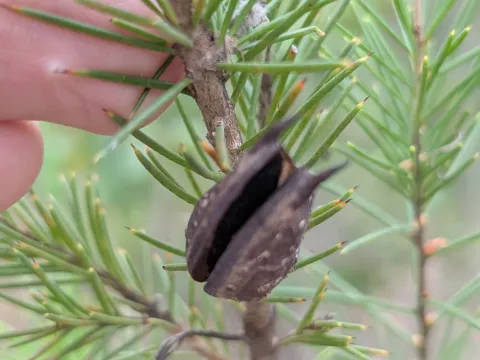
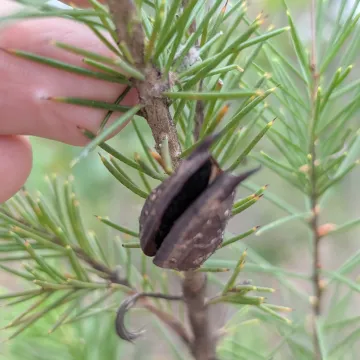
Botanically, Hakea sericea is characterized by needle-like leaves that are rigid and effective at preventing transpiration loss. The flowers are white to pale pink, arranged in clusters, and appear during the cooler months. The fruit is a woody follicle that remains closed until triggered by environmental stress, such as intense heat, reflecting its adaptation to fire-prone ecosystems.
Cultivation requirements for silky hakea are relatively low, focusing primarily on excellent soil drainage. It is notoriously sensitive to phosphorus, a common trait in many Proteaceae members, meaning standard fertilizers should be strictly avoided to prevent root damage. Propagation is primarily achieved through seeds, which often require exposure to heat to break dormancy, mimicking natural fire cycles.
Economically, silky hakea is used to establish impenetrable hedges that serve as effective windbreaks and security borders. Its wood is dense, and while it is not a primary timber species, it can be utilized for small-scale fuel production. In landscape architecture, it provides significant aesthetic value during its flowering phase, provided the plant is managed responsibly to prevent it from becoming a weed.
- Excellent drought tolerance in arid climates.
- High sensitivity to high-phosphorus soils and waterlogging.
- Effective for erosion control and wind protection.
- Fire-adapted reproductive strategy involving woody follicles.
Photo gallery