
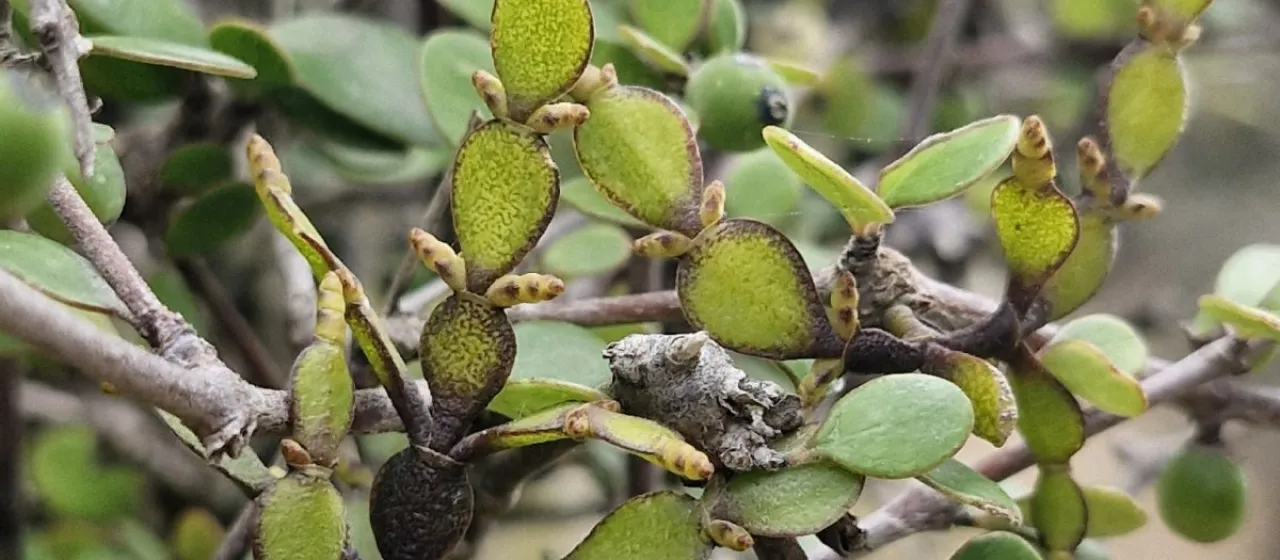
Description
Korthalsella lindsayi is a specialized plant species belonging to the Santalaceae family. It is recognized as a stem hemiparasite, meaning it derives essential nutrients and water from a host plant while still retaining the ability to perform limited photosynthesis. It is not an agricultural crop and is primarily of interest in the fields of plant biology and conservation.
The species is endemic to New Zealand, occurring within specific forest ecosystems where it colonizes various host woody species. Its distribution is entirely dependent on the presence of suitable host plants, such as those from the genera Coprosma or Myrsine, which provide the structural foundation for its growth.
Botanically, the plant exhibits significant adaptation to an epiphytic lifestyle, characterized by reduced, scale-like leaves and segmented, fleshy stems. It attaches to the host branches via specialized structures known as haustoria, which penetrate the host's bark and phloem to extract resources necessary for survival and reproduction.
There are no cultural practices or agrotechnical requirements for this plant, as it is strictly a wild species. It does not grow in soil and does not respond to standard fertilizers. Its survival is dictated by environmental stability, particularly ambient humidity and the overall vitality of the host population, which serves as both its habitat and nutrient source.
Economically, Korthalsella lindsayi has no agricultural or industrial use. In a forestry or horticultural context, it is occasionally viewed as a parasitic nuisance if it significantly impacts the health of valuable ornamental or native trees. Disease and pest management are generally not applicable, although the plant can be affected by specific fungal pathogens that target its succulent stem tissues.