
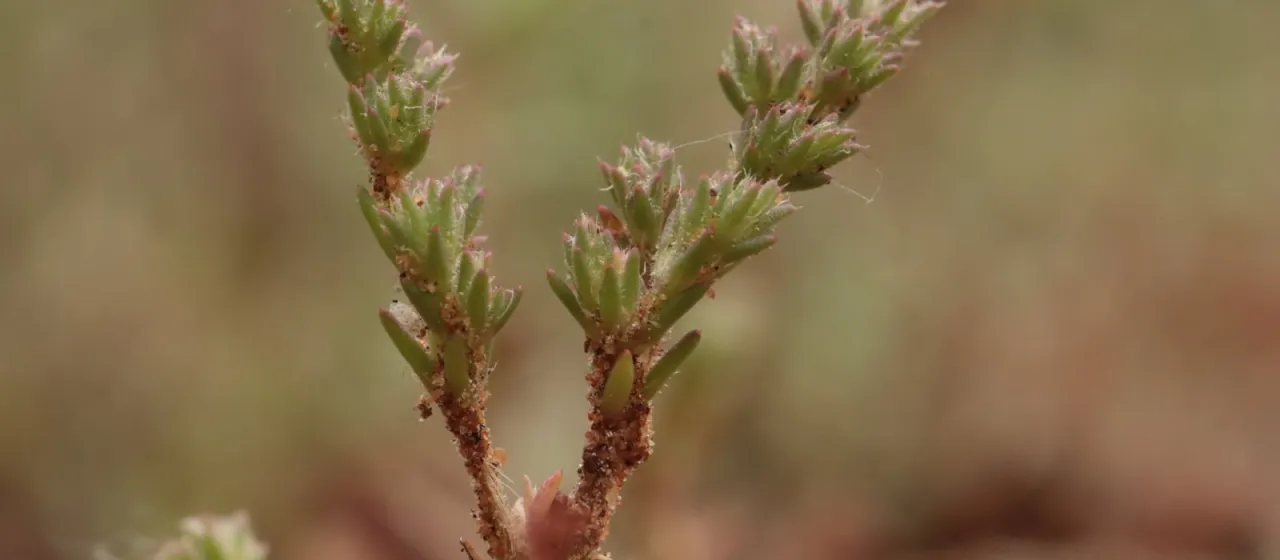
Description
Loeflingia hispanica is an annual herbaceous plant belonging to the Caryophyllaceae family. While not an agricultural crop in the traditional sense, it is a botanical species often encountered in dry, sandy environments and pasturelands. It plays a role as an opportunistic pioneer species in disturbed soils.
The species originates from the Mediterranean basin and Western Europe. Its native range is characterized by long, hot, and dry summers, which have forced the plant to evolve a short life cycle. It has also successfully naturalized in various regions of North America, where it thrives in sandy, nutrient-poor landscapes.
Botanically, it is a prostrate or ascending herb reaching heights of 5 to 15 cm. The stems are densely branched, and the leaves are small, narrow, and opposite. The flowers are tiny, solitary or in small clusters, typically featuring five sepals, while the petals are either very small or sometimes absent, reflecting a strategy for survival in arid climates.
Environmental requirements focus on well-drained, porous soils. Loeflingia hispanica thrives in sunny locations with minimal competition from taller vegetation. It is highly drought-tolerant, germinating early in the spring when moisture is available, and completing its seed production cycle before the onset of the peak summer drought.
From an agronomic perspective, this plant is treated as an invasive weed in pastures or marginal croplands. It does not carry significant diseases, but it can host pests common to the Caryophyllaceae family. Control measures primarily involve mechanical soil cultivation or the enhancement of competitive crop growth through proper fertilization and irrigation management.