Cajuput tree
Melaleuca cajuputi Powell
Description
The Cajuput tree (Melaleuca cajuputi Powell) is a perennial evergreen plant belonging to the Myrtaceae family. This species is widely recognized for its robust nature and its significant economic importance, particularly in the tropical regions of Southeast Asia and Northern Australia.
Originating from humid coastal areas and flood-prone plains, the Cajuput tree is well-adapted to environments that would prove challenging for most other commercial tree species. Its natural range extends through Indonesia, Malaysia, Vietnam, and parts of Australia, where it thrives in swampy, acidic soil conditions.
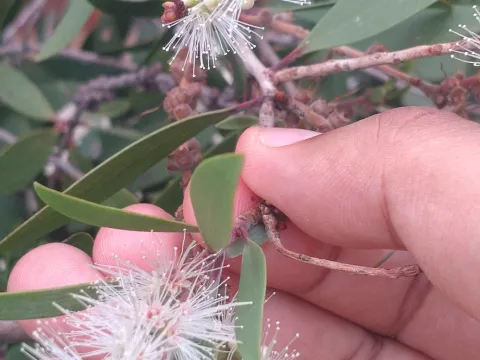
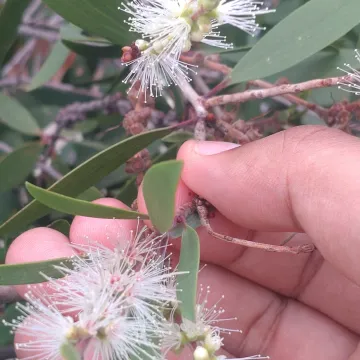
Botanically, the tree is distinguished by its iconic flaky, papery bark, which acts as a protective layer against fires and physical damage. The leaves are lanceolate, leathery, and rich in volatile oils, while the flowers are arranged in dense, bottlebrush-like spikes that produce a nectar highly sought after by local pollinators.
Regarding cultivation, the species requires full sun exposure and a hot, humid climate to reach its full growth potential. While it exhibits remarkable tolerance for poor, acidic, and waterlogged soils, it does not perform well in arid environments, as it relies on a steady supply of moisture to sustain its metabolism.
The primary economic output of Melaleuca cajuputi is its essential oil, known as cajuput oil, which is highly valued for its analgesic, antiseptic, and decongestant properties. Furthermore, the tree is frequently harvested for its durable, rot-resistant timber, often used in construction and the manufacturing of furniture.
- Exceptional tolerance to soil acidity and waterlogging.
- Rich content of 1,8-cineole in essential oils.
- Resilience to fire due to multi-layered bark.
- Significant role in regional ecosystem stability.
Photo gallery