
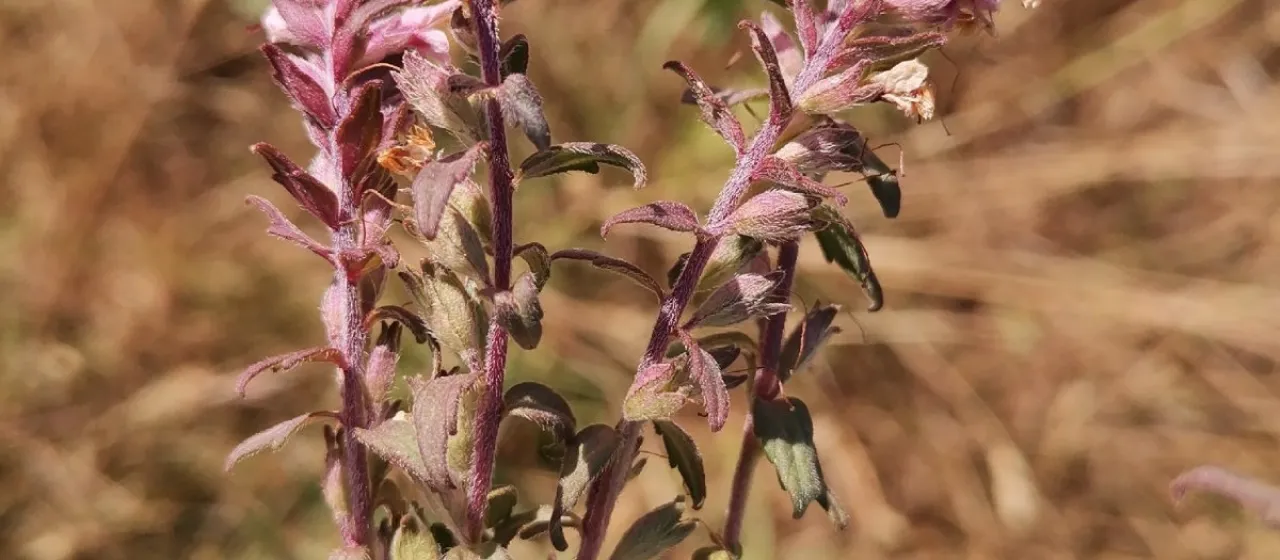
Description
Red bartsia (Odontites vulgaris) is an annual herbaceous plant belonging to the Orobanchaceae family. Known for its semi-parasitic nature, it possesses specialized structures called haustoria that penetrate the roots of host plants, allowing it to supplement its nutrient uptake from neighboring vegetation, although it still retains the ability to photosynthesize.
The native range of the species covers most of Europe and parts of temperate Asia. It is commonly found in a variety of open habitats, such as damp meadows, coastal grasslands, grassy embankments, and the edges of cultivated fields. It thrives best in sunlight, making it a characteristic feature of meadow vegetation during the summer months.
Botanically, the plant typically reaches a height of 15 to 50 cm. Its stems are often reddish and branched, bearing narrow, lanceolate leaves with distinctive teeth along the margins. The flowers, which appear in late summer, are arranged in one-sided racemes and feature a reddish-pink hue, which is highly attractive to a variety of pollinating insects.
The soil requirements for Odontites vulgaris include a preference for damp to moderately dry ground. While it can grow on various soil types, it is frequently found in areas with some degree of disturbance, such as roadside verges or damp pastures. As it is not an agricultural crop, there are no standard cultivation practices, but it is recognized as a component of healthy, diverse meadow ecosystems.
From an ecological perspective, red bartsia serves as a source of nectar for various pollinators, including bees and butterflies. Because it is not a commercial crop, there are no specific management practices for pests or diseases. However, the plant is susceptible to habitat degradation, particularly the drainage of wetlands and the aggressive application of broad-spectrum herbicides in agricultural settings.