
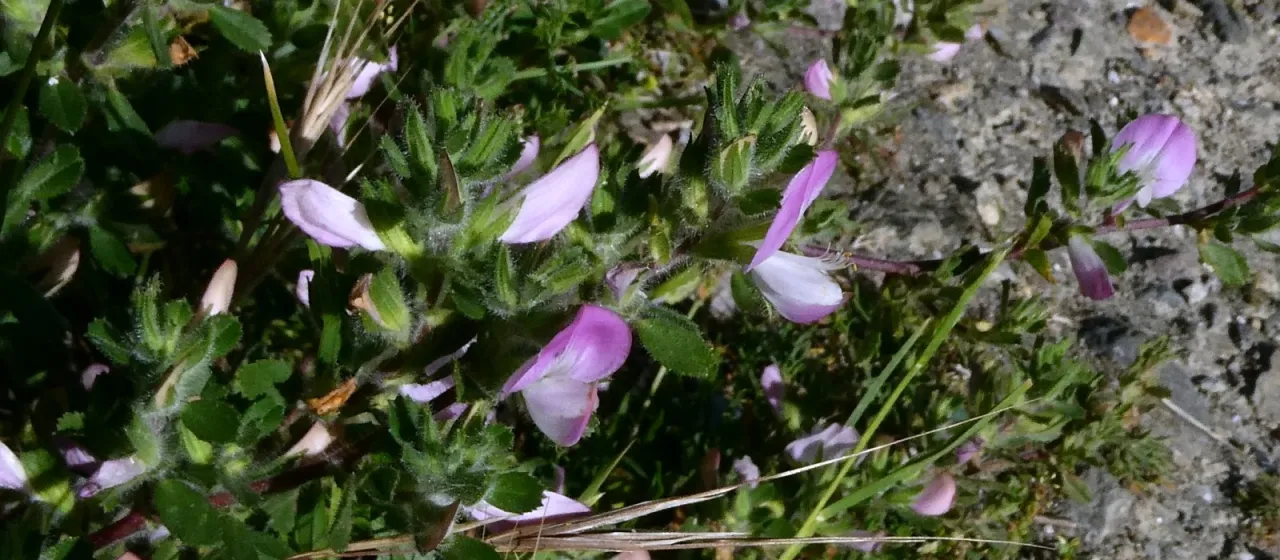
Description
Creeping restharrow (Latin: Ononis repens L.) is a perennial herbaceous plant belonging to the Fabaceae family. While frequently classified as a weed in agricultural landscapes, it is a significant species in ethnobotany and herbal medicine due to its complex chemical profile and hardy nature.
The plant is native to Europe and parts of Western Asia. It thrives in temperate regions and is commonly found on sandy soils, coastal dunes, grasslands, and roadsides. Its natural habitat suggests a high adaptability to dry conditions and nutrient-poor, rocky or sandy substrates, reflecting its evolutionary success in diverse European climates.
Botanically, the creeping restharrow is distinguished by a deep-reaching, woody root system that allows the plant to survive droughts and mechanical disturbances. The stems are generally covered in glandular hairs and can be prostrate or erect. The leaves are trifoliate with serrated edges. During the flowering period, from early summer to August, it produces distinctive pea-like, pink flowers.
Regarding agrotechnical management, this species demands full exposure to sunlight and excellent soil drainage. It is highly intolerant of waterlogged soil, which can lead to rapid decay of the root system. No intensive fertilization is required as the plant, being a legume, contributes to soil fertility by nitrogen fixation, making it a low-input species for cultivation purposes.
The primary economic and industrial value of creeping restharrow lies in its roots, which are harvested for pharmaceutical applications. They contain potent flavonoids, saponins, and essential oils. These extracts are recognized for their diuretic, laxative, and anti-inflammatory properties, making them a staple in the production of herbal remedies for various urological and digestive issues.
- Excellent adaptation to sandy and poor soils.
- Role in nitrogen fixation for soil improvement.
- Resilience against drought and wind.
- Specific susceptibility to root rot in poorly drained areas.