Grayish rock spirea
Petrophytum cinerascens
Description
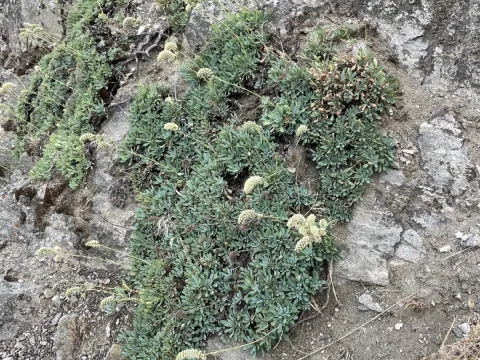
Grayish rock spirea (Petrophytum cinerascens) is a perennial shrub belonging to the Rosaceae family. This distinct alpine plant is highly prized for its low-growing, mat-forming habit and its exceptional ability to thrive in extremely harsh environments where few other ornamental species can survive.
The origin of this species is confined to a very narrow geographic range in Washington State, USA. Naturally found clinging to basaltic cliff crevices, the plant has evolved to withstand high wind exposure and significant seasonal temperature fluctuations, making it a true specialist of rocky, high-altitude or cliff-face habitats.
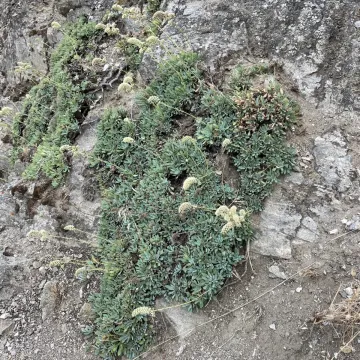
Botanically, it is defined by its dense, woody base and rosettes of silvery-green, pubescent foliage that creates a cushion-like appearance. During the blooming season, the plant produces erect, spike-like inflorescences covered in tiny, creamy-white flowers, which contrast beautifully against the foliage throughout the summer months.
Cultivation requires careful attention to soil composition and water management. To mimic its natural rocky environment, it is essential to use a highly gritty, fast-draining substrate. The plant demands full sun to maintain its compact form and vibrant leaf color; it should not be planted in shade or moisture-retentive soils, as these will lead to structural decline and poor growth.
In landscape design, it is primarily used in rock gardens, scree beds, or as a specialty specimen for wall planting. The species is highly resistant to traditional garden pests and diseases, provided that air circulation is adequate and root rot is prevented by proper drainage. Propagation is typically achieved through seeds or careful division during the spring, although growth is generally slow, emphasizing the need for patience.
Photo gallery