Juniper haircap moss
Polytrichum juniperinum
Description
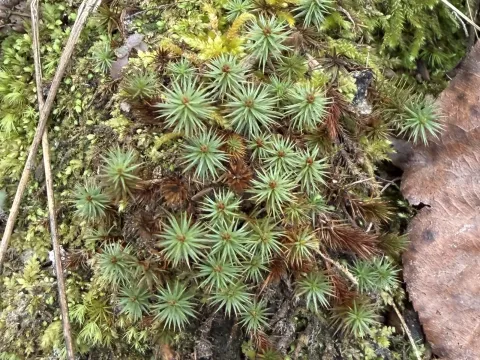
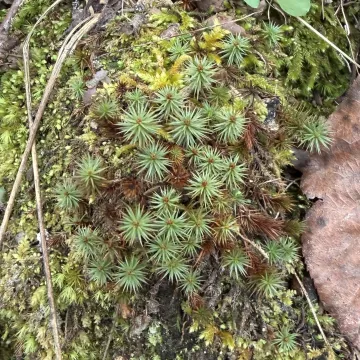
Polytrichum juniperinum, commonly known as juniper haircap moss, is a significant member of the Polytrichaceae family. It is a perennial acrocarpous moss that is easily identified by its distinctive leaves with clear, serrated tips that often give the colony a reddish-brown or silvery appearance when dry.
The species has a cosmopolitan distribution, thriving in a wide range of habitats across all continents, including the Antarctic. It is a classic pioneer species, frequently occupying poor, acidic, sandy soils, heathlands, and areas that have suffered from recent fire or erosion. Its ability to tolerate low-nutrient substrates makes it an essential component of many early successional ecosystems.
Botanically, the plant forms dense, upright stems that can reach heights of up to 10 centimeters. The leaves are narrow and lance-shaped, featuring a thick midrib covered in lamellae, which are specialized structures designed to maximize photosynthetic efficiency while minimizing water loss. These adaptations allow the moss to survive in environments that would be lethal to more sensitive bryophytes.
In terms of cultivation, Polytrichum juniperinum is primarily managed for its soil-binding properties rather than as a traditional crop. It requires a stable, acidic environment with moderate light levels. Unlike vascular plants, it does not require fertilization; in fact, the addition of nitrates can be detrimental, as it encourages competing vegetation that eventually shades out the moss.
Its хозяйственное (economic/practical) use is centered on niche environmental applications:
- Erosion control on sandy embankments and roadsides.
- Use in specialized landscaping and rock garden design.
- Monitoring of heavy metal or atmospheric pollution, as the moss acts as a bio-accumulator.
There are no major pests or diseases that affect juniper haircap moss in the field. Its greatest threats are mechanical disturbance, such as heavy foot traffic, and the encroachment of grasses or shrubs. It is a robust organism that requires minimal intervention, provided that the physical integrity of the moss mat and the acidic pH balance of the underlying substrate are maintained.
Photo gallery