Round-leaf mintbush
Prostanthera rotundifolia
Description
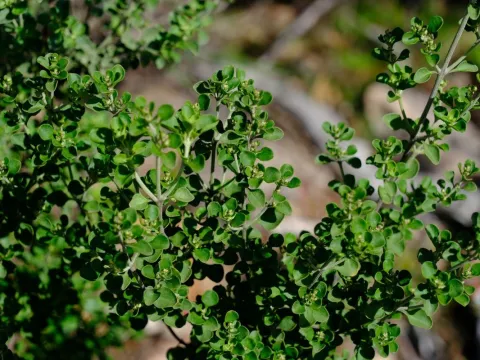
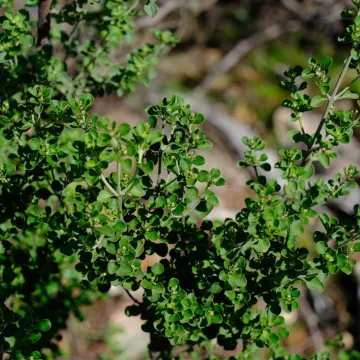
Round-leaf mintbush (Latin: Prostanthera rotundifolia) is an evergreen shrub belonging to the Lamiaceae family. It is widely recognized for its intensely aromatic foliage, which releases a distinct fragrance similar to mint and eucalyptus when crushed, earning it the popular name of Australian mint.
The species is native to southeastern Australia, with its primary range spanning New South Wales, Victoria, and Tasmania. In its natural environment, the plant thrives in the understory of eucalyptus forests and on rocky slopes, where it benefits from a stable, temperate climate and well-drained, nutrient-rich woodland soils.
Botanically, this shrub grows to a height of 1 to 3 meters, featuring dense branching and small, rounded, slightly serrated leaves. During the spring and early summer flowering season, the shrub produces a stunning display of bell-shaped flowers ranging from pale mauve to deep violet, which cover the entire bush.
Cultivation requires specific attention to soil drainage and sun exposure. The plant prefers partial shade in hot climates and thrives in acidic to neutral, well-draining soils. Because it is sensitive to heavy frosts, it is commonly treated as a container plant in temperate regions, allowing for protection during extreme winter conditions.
The primary use for Prostanthera rotundifolia is within horticulture and landscape design. Its utility is highly valued by gardeners for several key characteristics:
- Excellent ornamental value for gardens and indoor collections;
- High tolerance for varied light conditions;
- Natural pest-repelling properties due to aromatic essential oils;
- Suitability for structured pruning and shaping into hedges.
Common issues include root rot caused by poor soil drainage and susceptibility to pests like spider mites if the environment becomes too hot and dry. To maintain plant health, gardeners should ensure moderate watering, regular feeding with a slow-release fertilizer, and light pruning immediately after the flowering period to encourage new growth.
Photo gallery