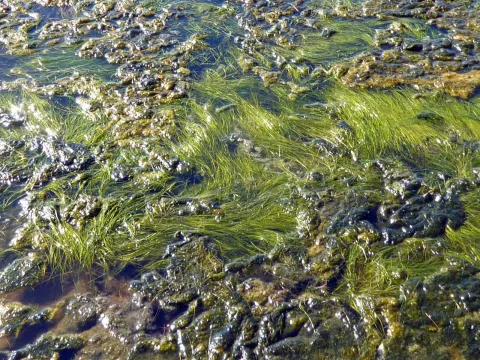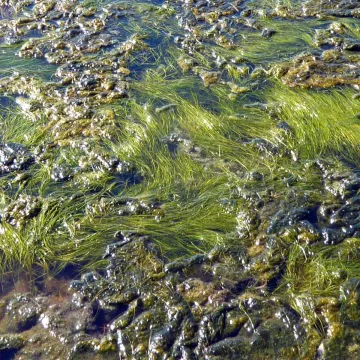
Large-fruited ditch grass
Ruppia megacarpa
Description
Ruppia megacarpa, commonly known as large-fruited ditch grass, is a perennial submerged aquatic macrophyte belonging to the family Ruppiaceae. This species is specifically adapted to brackish and saline water environments, playing a critical ecological role in maintaining the health of coastal lagoons and estuarine systems.
The species is primarily native to the temperate regions of Southern Australia. It thrives in shallow, sheltered marine environments where it forms extensive submerged meadows. These meadows are essential for ecological stability, providing a structural foundation that supports a wide range of aquatic biodiversity in its natural range.
Botanically, Ruppia megacarpa is characterized by slender, branched stems and thin, linear leaves. A defining feature of its reproductive strategy is the spiral coiling of the peduncles, which raises the flowers to the water surface for pollination. The plant produces relatively large, distinct fruits, which serve as a primary diagnostic feature distinguishing it from other Ruppia species.
Regarding climate and soil requirements, the plant prefers sandy or silty-sand substrates with good light penetration. It is highly tolerant of varying salinity levels, ranging from nearly fresh to hypersaline conditions. Cultivation efforts currently focus on habitat restoration techniques, emphasizing the management of nutrient levels to prevent competitive algal blooms that inhibit the growth of the grass.
The primary хозяйственные uses of Ruppia megacarpa are in environmental management and biodiversity conservation. It serves as a vital food source for waterfowl and provides nursery habitat for juvenile fish and crustaceans. Furthermore, it is increasingly recognized for its role in biofiltration, helping to improve water quality in coastal protection projects and managed wetland systems.
- High tolerance to salinity fluctuations.
- Essential nursery habitat for aquatic fauna.
- Effective sediment stabilization capabilities.
- Unique surface-pollination mechanism.
Photo gallery