Spiny sowthistle
Sonchus asper (L.) Hill
Description
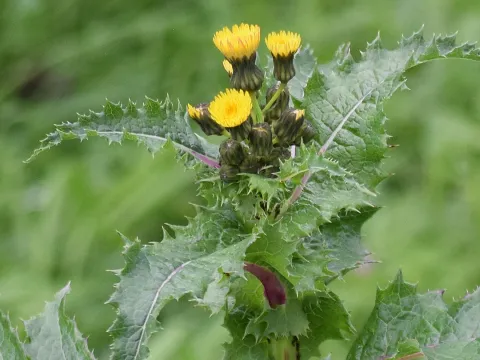
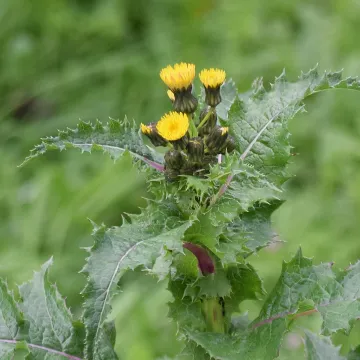
Spiny sowthistle (Latin Sonchus asper) is an annual herbaceous plant belonging to the Asteraceae family. It is recognized as a significant weed in agricultural systems worldwide. The plant is easily identified by its shiny, dark green leaves with prickly margins and rounded auricles that clasp the stem, which distinguishes it from other species of the Sonchus genus.
Originating from Europe, Northern Africa, and Western Asia, the spiny sowthistle has successfully naturalized in most temperate and subtropical regions of the world. It thrives in disturbed habitats, including arable fields, orchards, gardens, and along roadsides. Its success as a weed is largely due to its adaptability to various soil types, although it shows a preference for nutrient-rich, moist, and cultivated soils.
Botanically, Sonchus asper can grow up to 120 centimeters in height with a stout, hollow stem. Its taproot system allows it to compete effectively for deep-soil moisture. The plant produces yellow, dandelion-like flower heads throughout the growing season. A single plant can produce a vast quantity of seeds, which are equipped with feathery pappi, allowing for efficient long-distance dispersal by wind.
Effective management of spiny sowthistle requires a multifaceted approach to prevent seed bank replenishment. Recommended strategies include:
- Implementing deep tillage to destroy young rosettes.
- Using crop rotation to disrupt weed life cycles.
- Applying pre-emergence and post-emergence herbicides.
- Maintaining field borders to minimize seed invasion.
- Encouraging rapid crop canopy closure to shade out weed seedlings.
Economically, this species is considered a major pest because it competes with crops for sunlight, water, and nutrients, often leading to significant yield losses. Furthermore, it serves as a host for various agricultural pests, including aphids and whiteflies, and can harbor several plant viruses. Due to its prickly nature, it can also complicate manual harvest and irritate the skin of farm workers.
Photo gallery