Bituminaria bituminosa
Bituminaria bituminosa (L.) C. H. Stirt.
Description
Bituminaria bituminosa, commonly known as pitch trefoil, is a perennial legume species belonging to the Fabaceae family. The plant is easily distinguished by its characteristic resinous, bitumen-like scent, which serves as a natural deterrent against certain herbivores in its wild state.
Native to the Mediterranean basin, the species is widely distributed across Southern Europe, North Africa, and the Middle East. It has evolved to thrive in harsh, dry environments where many conventional agricultural crops would fail, making it a subject of interest for sustainable farming in arid regions.
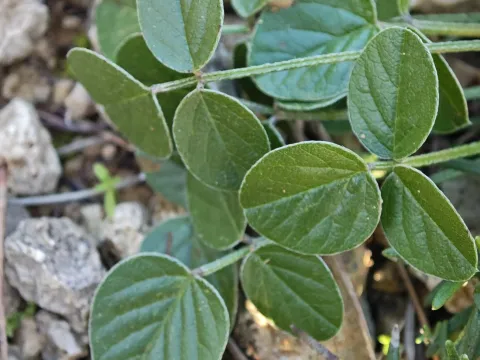
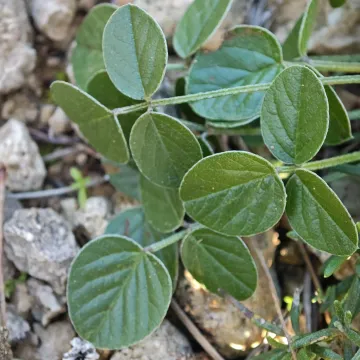
Botanically, it features a robust taproot system that provides drought resistance and helps stabilize rocky or degraded soils. The foliage consists of trifoliate leaves, and the plant produces clusters of blue-to-purple flowers. Its growth habit is semi-shrubby, allowing it to provide cover and forage over several years.
Cultivation requirements favor well-drained, alkaline to neutral soil types with plenty of sun exposure. While the plant is inherently hardy, initial establishment requires careful management to ensure the seedlings are not outcompeted by weeds. Once established, it requires minimal maintenance and is highly tolerant of grazing pressure.
Economically, it is primarily used as a high-protein forage crop for small ruminants such as sheep and goats. Beyond its nutritional profile, research is ongoing into its phytochemical properties for industrial applications and its role in soil improvement and nitrogen fixation in degraded agricultural lands.
- Exceptional tolerance to drought and poor soil quality.
- Rich source of proteins and essential nutrients for livestock.
- Excellent ground cover for erosion control.
- High potential for nitrogen fixation to boost soil health.
Photo gallery