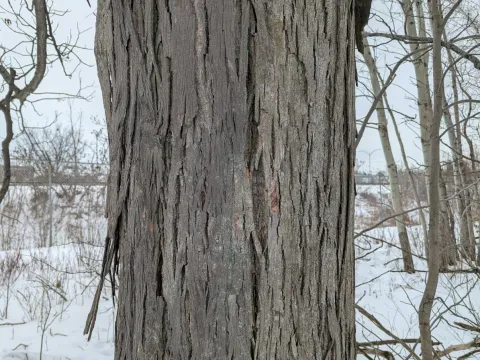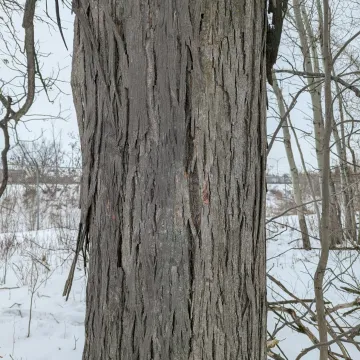

Shagbark hickory
Carya ovata (Mill.) K. Koch
Description
Shagbark hickory (Carya ovata) is a deciduous tree belonging to the walnut family, Juglandaceae. It is best known for its distinctive shaggy bark that peels away in long, vertical strips as the tree matures. This robust species can reach heights of over 30 meters and is a defining feature of deciduous forests in eastern North America.
The native range of the Shagbark hickory extends across the eastern United States and parts of southeastern Canada. The tree thrives in various soil types but demonstrates a clear preference for deep, moist, well-drained soils found on hillsides or in valley bottoms. It is highly valued for its ability to withstand cold climates, making it a hardy choice for temperate silviculture.
Botanically, the tree features compound leaves with five leaflets and produces a large, edible nut protected by a thick, woody husk. These nuts are a vital food source for wildlife and have been utilized by humans for centuries due to their sweet, rich flavor. The tree is monoecious, meaning it bears separate male and female flowers on the same plant, necessitating cross-pollination for optimal fruit production.
Agricultural management of Carya ovata requires patience, as the species is known for its slow initial growth rate and deep taproot system. Proper spacing is crucial to ensure adequate sunlight and airflow, which minimizes the risk of leaf spot diseases and pests like the hickory bark beetle. Planting should ideally take place in rich, loamy soil with a neutral pH to maximize nut yield.
- High cold tolerance and winter hardiness.
- Excellent timber quality, known for shock resistance.
- Slow initial development and long maturation cycle.
- Valuable nutritional profile of the harvested nuts.
In terms of economic utility, Shagbark hickory serves two primary sectors. Firstly, its wood is globally recognized as one of the strongest and toughest hardwoods, favored for tool handles, ladder rungs, and high-quality furniture. Secondly, the kernels are increasingly recognized as a nutrient-dense superfood, offering significant potential for boutique nut orchards and agroforestry projects.
Photo gallery