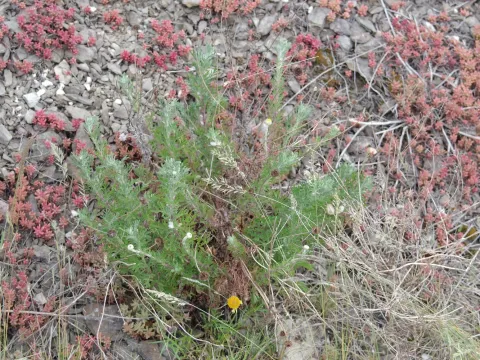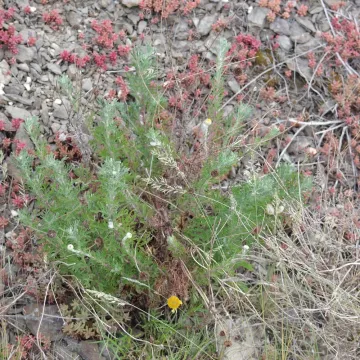
Dyer's chamomile
Cota tinctoria
Description
Dyer's chamomile (Cota tinctoria), widely recognized for its historical significance as a dye plant, belongs to the Asteraceae family. It is a robust perennial herb that has been cultivated for centuries across various temperate zones, demonstrating exceptional resilience and adaptability to different environmental conditions.
The plant originates from Europe and Western Asia, currently established in various regions globally where well-drained soils are available. Its ability to colonize diverse landscapes makes it a reliable crop for marginal agricultural lands. It thrives in open, sunny environments and is highly tolerant of drought, making it an excellent candidate for low-input farming systems.
Botanically, dyer's chamomile is characterized by its erect, branched stems reaching heights of 30 to 80 cm, adorned with finely dissected foliage. The plant produces vibrant yellow, daisy-like flower heads that remain in bloom throughout the summer months. These flowers are the primary source of the plant's valuable yellow pigment, which is concentrated in the ray and disc florets.
Agronomic requirements are straightforward, focusing on soil structure rather than fertility. The species prefers sandy or gravelly soils that provide optimal drainage. Key aspects of cultivation include:
- Direct seeding in spring or autumn.
- Minimal fertilization, as excessive nutrients can negatively impact oil quality.
- Low water requirements once the plant is established.
- Adequate weed control during the seedling stage.
Economically, dyer's chamomile is primarily valued for its natural dye compounds used in the textile industry and as a medicinal botanical with known anti-inflammatory properties. Common phytosanitary issues include powdery mildew and aphid infestations. Preventive measures, such as maintaining proper spacing to ensure airflow, are usually sufficient to manage these risks without heavy reliance on chemical pesticides.
Photo gallery