Crotalaria pallida
Crotalaria pallida Aiton
Description
Crotalaria pallida Aiton, commonly known as smooth rattlebox, is a plant species within the Fabaceae family. As a vigorous legume, it is widely recognized for its impressive biomass production and its high efficiency in biological nitrogen fixation, making it an essential crop for sustainable agricultural systems globally.
Originally native to tropical Africa, Crotalaria pallida has become naturalized in numerous tropical and subtropical regions across the globe, including Asia, the Pacific Islands, and the Americas. Its ability to thrive in diverse ecological conditions has led to its extensive use in soil restoration programs and as an integral part of crop rotation strategies.
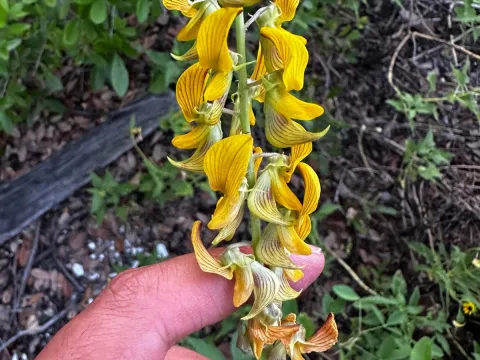
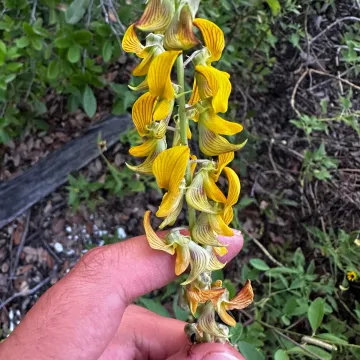
Botanically, it is an annual or perennial herbaceous shrub that can grow up to 2 meters tall. Its morphology includes trifoliate leaves with elliptical leaflets and bright yellow flowers arranged in terminal racemes. The fruits are cylindrical pods that turn brown upon maturity, containing numerous small, hard-coated seeds.
The cultivation of this species requires warm climate conditions, as it is highly sensitive to frost. It excels in well-drained soils and can withstand low soil fertility, which makes it an excellent pioneer species. The standard agronomic approach involves mechanical sowing in rows, followed by minimal cultivation until the plant forms a dense canopy that suppresses weed growth.
The agricultural utility of Crotalaria pallida is diverse and impactful:
- Serving as a highly productive green manure to enhance soil organic matter.
- Functioning as a trap crop to reduce nematode populations in the soil.
- Preventing erosion by providing continuous ground cover in tropical fields.
- Enhancing soil porosity through its deep and aggressive root system.
The crop is generally robust, but it can be susceptible to fungal pathogens like Rhizoctonia or Fusarium in waterlogged conditions. Pests such as various lepidopteran larvae and seed-boring insects may impact the production of seeds. Integrated pest management, focusing on proper drainage and field sanitation, is typically sufficient to ensure healthy crop development.
Photo gallery