Red-neck thread-moss
Dicranella cerviculata
Description
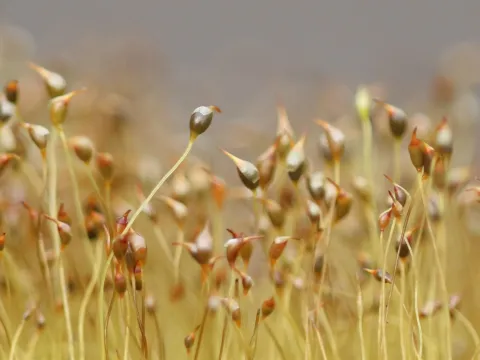
Red-neck thread-moss (Latin: Dicranella cerviculata) is a distinct species of moss belonging to the Dicranaceae family. While not a commercial agricultural crop, it is a significant organism in forest ecology, known for its ability to colonize specific substrates. It is widely recognized by botanists for its role in secondary succession, often appearing in areas where the forest soil profile has been disturbed.
The species has a broad distribution across the Northern Hemisphere, spanning across Europe, parts of Asia, and North America. It is typically found in temperate forest zones, favoring sites near wetlands, along forest drainage ditches, and on moist peat banks. Its presence is a strong indicator of localized damp, acidic soil conditions, which are critical for its vegetative development.
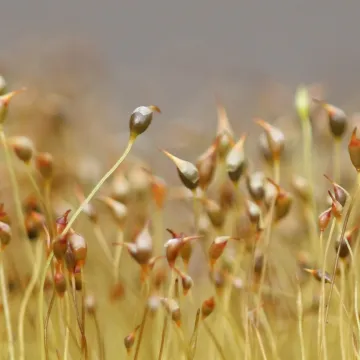
Botanically, this moss forms small, yellowish-green tufts that are often overlooked due to their diminutive size. The stems are short, typically ranging from one to three centimeters. The leaves are narrowly lanceolate, tapering into a distinct neck. The sporophyte, featuring a characteristically swollen, long-necked capsule, is the diagnostic feature used by taxonomists to differentiate this species from other closely related thread-mosses.
Its environmental requirements are strict: it thrives only in moist, acidic substrates (pH ranging from 3.0 to 5.0) with high organic content. The species is sensitive to desiccation and direct solar radiation, necessitating a stable microclimate provided by the forest canopy or sheltered peat bog edges. In terms of maintenance or management, it requires minimal disturbance to keep the soil moisture levels consistent.
In terms of ecological significance, Dicranella cerviculata serves as a living indicator of soil health and environmental stability. It is not prone to traditional agricultural pests, but it is highly susceptible to habitat degradation, such as drainage of wetlands or nitrogen deposition, which can alter soil pH and lead to its displacement. It is protected in several regions as part of the diverse moss flora contributing to natural soil erosion control.
- High preference for acidic, moist soils.
- Excellent bioindicator for monitoring soil acidity.
- Common pioneer species on damp, disturbed earth.
Photo gallery