Echeveria parva
Echeveria parva A. Berger
Description
Echeveria parva (A. Berger) is a small, visually striking succulent species belonging to the Crassulaceae family. It is highly valued in the nursery industry and among gardening enthusiasts for its miniature, rosette-forming habit and its resilience in well-managed, controlled environments.
Native to the arid and rocky mountainous regions of Mexico, this plant has evolved to thrive in environments with excellent drainage and seasonal variations in water availability. In commercial cultivation, it is managed as a decorative ornamental crop, grown primarily in greenhouses or indoor settings where the microclimate can be strictly regulated to meet its biological needs.
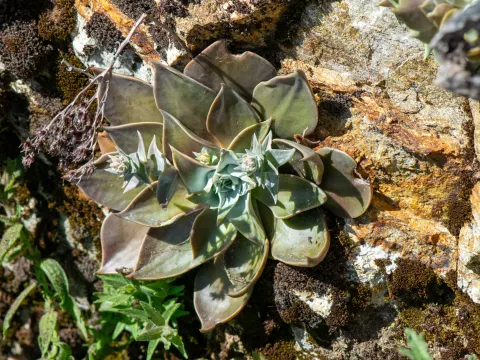
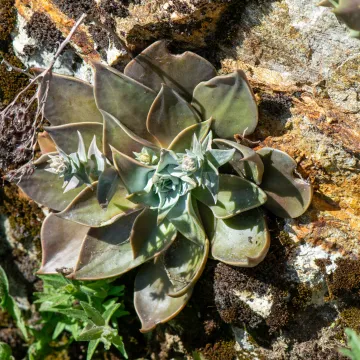
Botanically, Echeveria parva is characterized by its compact, succulent leaves arranged in dense, symmetrical rosettes. These leaves typically possess a grayish-green hue, sometimes with reddish margins depending on sun exposure, and are often covered in a natural waxy cuticle (epicuticular wax) that reduces transpiration. It produces delicate stalks of small, bell-shaped flowers during its active growing season.
Agronomic requirements are focused on high light intensity and precise water management. The soil medium must be highly porous, consisting of a mix of potting soil, coarse sand, and perlite to ensure rapid drainage and prevent stagnation around the root system. Over-watering is the most common cause of crop failure, making a "soak and dry" irrigation cycle essential for plant longevity.
- Bright, indirect light is required to maintain compact rosette form.
- Use a specialized, mineral-heavy soil mix with excellent drainage.
- Temperature control: avoid frost and extremes in humidity.
- Regular inspection for mealybugs, which tend to hide in leaf crevices.
The primary horticultural use of Echeveria parva is as a potted plant or a component in succulent arrangements and xeriscaping projects. While relatively resistant, the species is susceptible to root rot caused by fungi such as Phytophthora if the soil remains wet for extended periods, and it requires consistent airflow to mitigate disease pressure.
Photo gallery