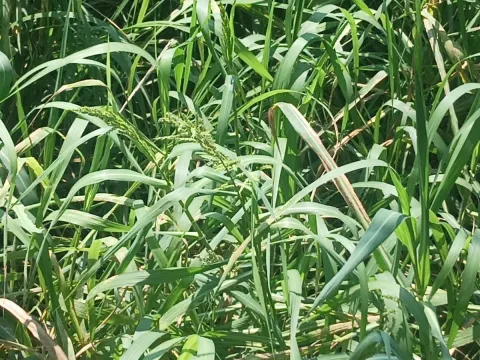

Antelope grass
Echinochloa pyramidalis
Description
Antelope grass (lat. Echinochloa pyramidalis) is a robust perennial grass species belonging to the Poaceae family. It is widely recognized in tropical agriculture for its exceptional biomass production and its unique ability to thrive in waterlogged or flooded environments.
Originating from tropical Africa, this plant has spread across various tropical regions globally. It is predominantly found in wetlands, floodplains, and riverbanks, where it naturally forms extensive, dense colonies. Due to its hardiness, it has become a staple forage crop in regions where other grasses fail during the rainy season.
Botanically, the plant is characterized by its significant height, often reaching up to two meters or more. It has long, linear leaves and a sturdy stem structure. Its root system is exceptionally vigorous, allowing it to anchor securely in soft, saturated soils, which also makes it an excellent plant for soil conservation purposes.
Regarding climate and soil requirements, Antelope grass thrives in high-temperature environments with ample water availability. It is highly tolerant of anaerobic soil conditions. Agrotechnical practices focus on vegetative propagation using rhizome cuttings, which is more reliable than seed-based establishment. Management involves periodic mowing to encourage young, nutrient-rich growth.
The primary agricultural use of Antelope grass is as a high-quality fodder for livestock. It can be grazed directly or harvested for hay or silage production. Additionally, it serves as an important ecological plant for stabilizing river banks and managing water-saturated landscapes where traditional crops cannot survive.
Typical pests and diseases include stem borers and various fungal pathogens that can affect the foliage during periods of stagnant water. Effective management involves avoiding overgrazing and ensuring that the grass is harvested at the peak of its nutritional value, which helps maintain the health and vigor of the stand over several seasons.
Photo gallery