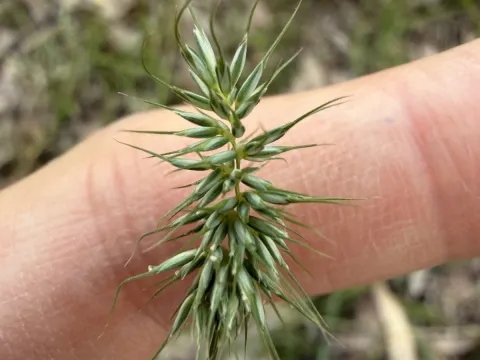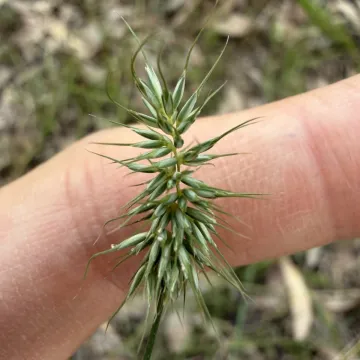
Tufted hedgehog grass
Echinopogon caespitosus
Description
Tufted hedgehog grass (Echinopogon caespitosus) is a perennial grass species belonging to the Poaceae family. It is an indigenous plant characterized by its robust growth habit and resilience to various environmental stresses, commonly studied in the context of grassland management and sustainable range feeding.
The native distribution of this species is centered in Australia. It thrives in open woodlands and grasslands, showing a strong adaptation to climatic conditions where seasonal shifts are significant. Its ability to colonize diverse landscapes makes it a notable representative of Australian native grasses that have potential for managed livestock systems.
Botanically, the plant is distinguished by its dense, tufted habit, which serves as a protective mechanism against environmental extremes. The leaves are typically narrow and stiff, while the inflorescence is a distinct spike-like panicle, characteristic of the genus Echinopogon. This structure allows the plant to efficiently distribute seeds while maintaining structural integrity during gusty wind conditions.
In terms of agricultural requirements, the species prefers well-drained soils and demonstrates moderate tolerance to different soil pH levels. Agronomic management involves periodic monitoring of grazing pressure; overgrazing during the establishment phase can be detrimental, while controlled rotational grazing promotes healthier root development and ensures the long-term productivity of the pasture.
The primary agricultural use of Echinopogon caespitosus is as a grazing resource. It provides adequate forage for sheep and cattle during active growth periods. Potential health issues for the crop include fungal leaf rusts in high-humidity seasons, and occasional damage from grass-feeding insects, though the species generally maintains good resistance when managed under optimal density conditions.
Photo gallery