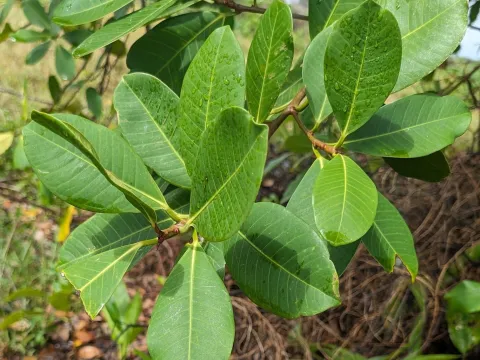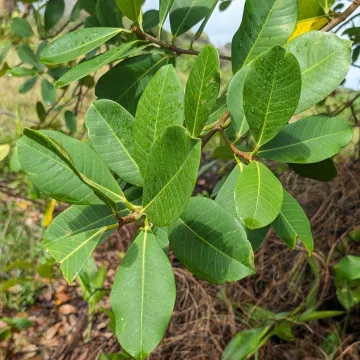
Guianan American fig
Ficus americana Aubl. subsp. guianensis (Ham.) C. C. Berg
Description
The Guianan American fig (Ficus americana Aubl. subsp. guianensis) is a perennial plant belonging to the Moraceae family. It is recognized as a complex subspecies that typically exhibits an epiphytic or hemiepiphytic growth habit, often starting its life cycle in the canopy of larger rainforest trees before establishing its own root system in the soil.
Originating from the tropical regions of Central and South America, this plant is well-adapted to the humid, shaded environments of rainforests. Its geographical distribution spans from the Caribbean islands to the tropical basins of the Guianas and the Amazon, where it plays a critical role as a foundational species in the local forest ecosystem.
Botanically, the species is defined by its coriaceous leaves and specialized inflorescences known as syconia. These fruit-like structures are not only essential for the plant's reproduction via its obligate pollinator wasps but also serve as a vital food source for a wide variety of tropical fauna, including birds, primates, and bats, thereby promoting biodiversity in its habitat.
In terms of agricultural requirements, the species thrives in warm climates with consistent humidity levels. The soil should be fertile, well-draining, and rich in organic matter to support its rapid biomass accumulation. Cultivation practices involve managing light exposure to prevent leaf scorch and ensuring that the substrate does not become waterlogged, which can trigger root pathogens.
When it comes to plant protection, the Guianan American fig is susceptible to common tropical pests such as scale insects and spider mites. Proactive pest management and maintaining optimal environmental conditions are key to preventing infestations. In agricultural practice, this plant is valued for reforestation efforts, ornamental landscaping, and providing necessary shade for secondary crops within agroforestry systems.
- Excellent potential for vertical greening in tropical greenhouse environments.
- Requires precise pruning for aesthetic shape control.
- Sensitive to low-temperature stress; requires sheltered locations.
- Biological interaction with pollinating wasps is crucial for fruit set.
Photo gallery