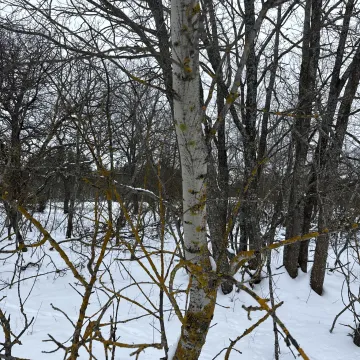

Grey poplar
Populus x canescens (Aiton) Sm.
Description
The Grey poplar (Populus x canescens) is a fast-growing hybrid tree species belonging to the Salicaceae family. It is a natural cross between the white poplar and the common aspen. This species is highly regarded in silviculture due to its impressive growth rate and the quality of its wood, which serves as a vital raw material for various industrial applications.
Originating from Europe and parts of Western Asia, the Grey poplar is widely cultivated in temperate regions across the globe. Its natural habitat is typically found in alluvial forests and riverside plains, where it thrives in moist, deep, and nutrient-rich soils. It has shown excellent adaptability to various climatic conditions, provided that soil moisture remains sufficient.
Botanically, the species is distinguished by its bark, which is smooth and greenish-grey in youth, eventually becoming darker and deeply fissured on older trees. The leaves are ovate, with a characteristic greyish-white pubescence on the undersides. The tree produces catkins in early spring, often before the foliage emerges, facilitating wind pollination.
Agronomic requirements center on selecting fertile sites with stable water levels. While the tree is robust, it requires full sunlight to achieve maximum growth potential. Proper management includes monitoring for common pests, such as aphids and fungal diseases like rust or leaf spot. Regular thinning of plantations is essential to ensure adequate air circulation and to minimize disease outbreaks.
In terms of economic utility, the Grey poplar is extensively used in the paper and pulp industry, the production of plywood, and as a sustainable source of biomass for bioenergy. Furthermore, its ability to act as a carbon sink and its effectiveness in preventing soil erosion make it an ideal choice for reforestation projects and environmental stabilization programs.
- Rapid biomass accumulation.
- Tolerance to damp soil conditions.
- High value in the pulp and paper industry.
- Excellent for windbreak and shelterbelt plantings.
Photo gallery