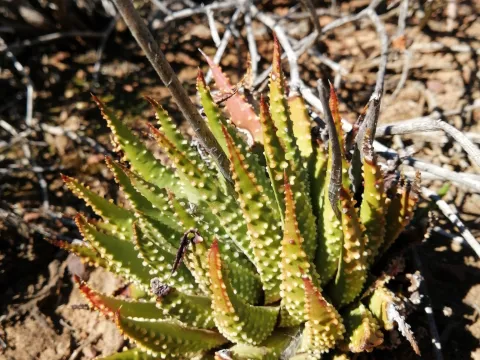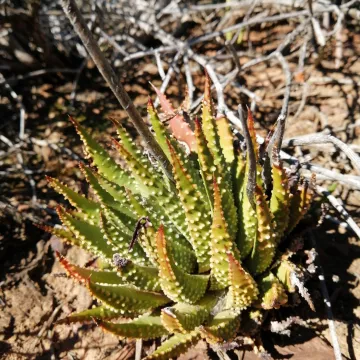
Haworthia maxima
Haworthia maxima (Haw.) Duval
Description
Haworthia maxima is a perennial succulent plant belonging to the Asphodelaceae family. Known for its rosette-forming, fleshy leaves, this species is highly valued in the horticultural world for its distinctive appearance, characterized by prominent white tubercles on the leaf surface. It is a slow-growing plant that maintains its architectural structure over many years.
The plant originates from the arid regions of the Cape Province in South Africa. In its native habitat, it grows in rocky terrains, often sheltered by rocks or larger vegetation, which allows it to thrive in nutrient-poor soils with irregular water supply. These environmental adaptations make it a hardy specimen for hobbyists and professional growers alike.
Botanically, Haworthia maxima is recognized by its stiff, lance-shaped leaves arranged in a dense rosette. The leaf epidermis is often rough, covered in white pearly structures that contrast with the deep green or brownish-green color of the plant tissue. Its root system is specialized for water storage, allowing the plant to remain dormant for long periods during droughts.
Cultivation requirements focus on mimicking its natural desert-like conditions. A highly porous, well-draining soil mix is mandatory to prevent root rot. While the plant can tolerate lower light levels compared to other succulents, it grows best in bright, indirect sunlight. Overwatering is the most common cause of failure in cultivation, as excess moisture easily leads to fungal infections.
- Light: Bright, indirect sunlight; avoid harsh midday sun.
- Soil: Gritty, inorganic mix (pumice, perlite, coarse sand).
- Watering: Soak and dry method; minimal water in winter.
- Temperature: Ideal range +18°C to +25°C.
Common pests include mealybugs, which tend to hide between the leaf bases, and spider mites in very dry conditions. Management involves mechanical removal or the application of systemic insecticides. As an ornamental crop, Haworthia maxima is primarily used in xeriscaping, container gardening, and private collections, serving as an excellent example of structural botanical design.
Photo gallery