
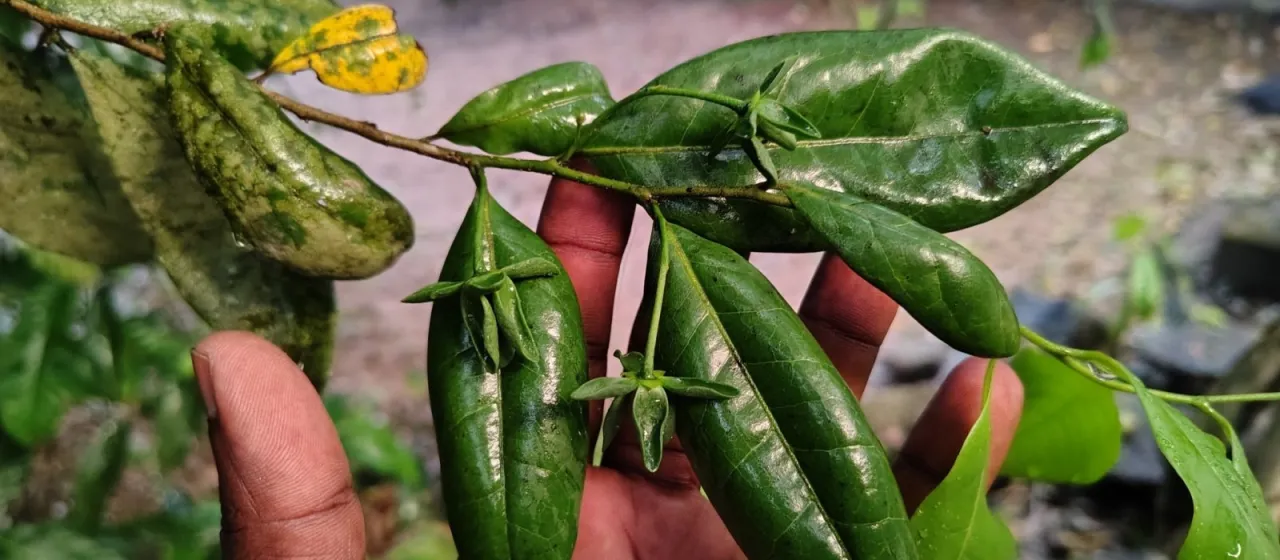
Description
Huberantha korinti is a perennial woody plant belonging to the Annonaceae family. Formerly classified under the genus Polyalthia, this species has been re-evaluated by botanists and assigned to the genus Huberantha. It stands as a significant, though specialized, botanical entity within the tropical flora of South and Southeast Asia.
The native distribution area of Huberantha korinti spans the tropical forests of India and Sri Lanka. Thriving in humid and warm environments, the plant is biologically adapted to heavy rainfall and consistent tropical temperatures. It is not cultivated on a massive commercial scale but remains a subject of interest in ethnobotanical studies and conservation efforts within its range.
Botanically, it is an evergreen shrub or tree characterized by its leathery leaves and unique floral structure, typical for the Annonaceae family. The flowers are specifically structured to attract localized pollinators, ensuring reproduction in dense forest understories. The bark is relatively smooth, and the overall plant architecture tends to be slender yet dense under optimal forest conditions.
Regarding agrotechnical requirements, the plant demands well-draining, nutrient-rich soils with a slightly acidic profile. It is highly sensitive to waterlogging, which can lead to rapid root rot, a common issue in tropical gardening. Cultivation in non-native regions is virtually impossible without specialized greenhouse environments that can maintain high humidity and steady temperatures throughout the year.
The хозяйственное utility of Huberantha korinti is primarily focused on traditional medicine and research. The plant contains various alkaloids and phytochemicals that are actively studied for their biological activity. While its timber is sometimes used for small-scale local crafts, the primary value lies in its ecological role and the potential pharmaceutical applications of its secondary metabolites.
- Requires consistently high atmospheric humidity levels.
- Needs protection from direct, intense solar radiation.
- Sensitive to nutrient deficiencies in alkaline soils.
- Propagation primarily via seeds or semi-hardwood cuttings.