
Description
The Purple toothwort (Lathraea clandestina) is a fascinating herbaceous perennial belonging to the Orobanchaceae family. As an obligate root parasite, it lacks chlorophyll, which forces it to extract all necessary nutrients and water from the roots of its host trees, primarily species like willow, poplar, and alder.
The plant is native to Western Europe, with its natural habitat concentrated in humid, shaded forest areas. It thrives in proximity to water sources, such as riverbanks and damp woodlands, where the root systems of potential hosts are extensive and provide the necessary support for the parasite's development.
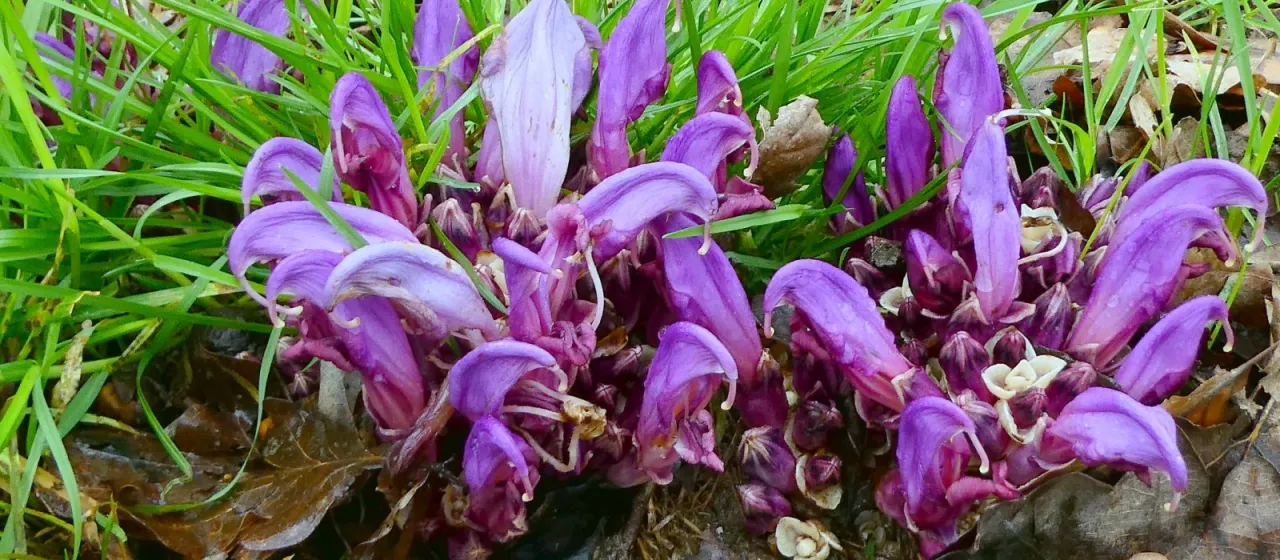
Botanically, Lathraea clandestina is highly specialized. The majority of the plant body remains subterranean, functioning through a complex network of rhizomes. Its only visible parts are the vivid purple or violet flowers that emerge from the soil in early spring, creating a distinct visual display in the leaf litter before the forest canopy fully develops.
In terms of agricultural or economic utility, the Purple toothwort has no commercial value as a crop. It acts as an ecological component within forest ecosystems. Because it relies entirely on its host, standard agricultural practices such as irrigation, fertilization, or crop rotation are not applicable. It is strictly a wild species that requires intact natural conditions to survive.
The survival of this species is highly dependent on the stability of its environment. It does not suffer from typical pests that affect conventional crops, as its primary "defence" is its cryptic, subterranean lifestyle. Conservation efforts are focused on preserving its natural habitat, as any significant disruption to the riparian woodland ecosystems will directly threaten its existence.