
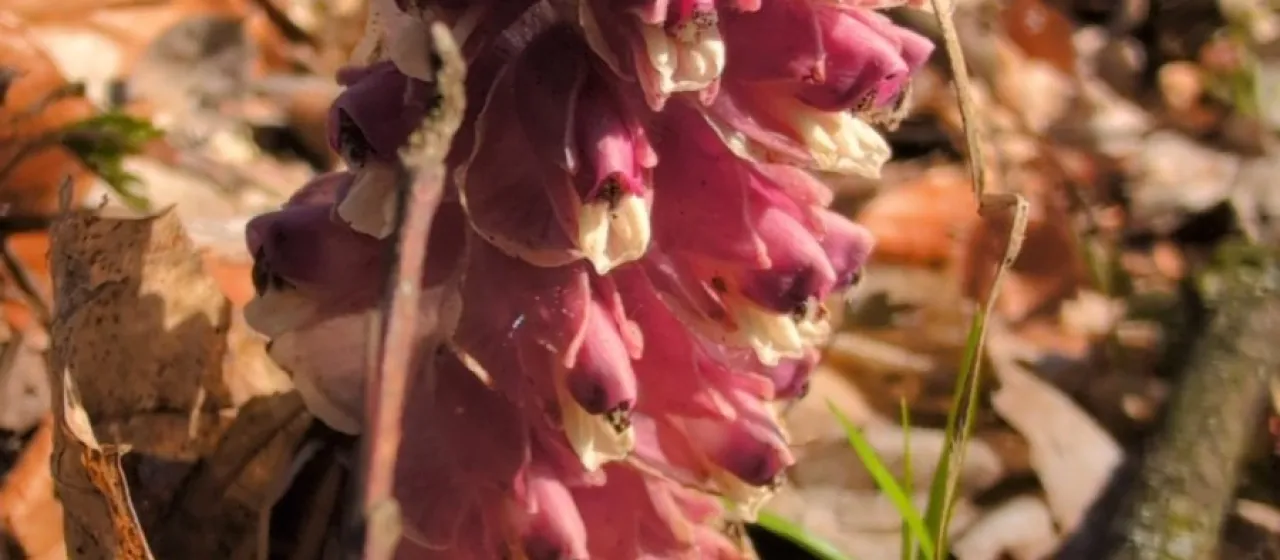
Description
Toothwort (Lathraea squamaria) is a perennial, holoparasitic plant belonging to the Orobanchaceae family. Unlike conventional agricultural crops, this species lacks chlorophyll and is incapable of photosynthesis, relying entirely on host plants for nutrients and water through specialized root connections called haustoria.
The plant originates from Europe and Western Asia, where it inhabits humid, shady deciduous woodlands. It typically parasitizes the root systems of trees such as hazel, alder, beech, and poplar. Because it competes with its hosts for resources, it is never cultivated as a crop; rather, it is recognized as a wild botanical species of forest ecosystems.
Botanically, Lathraea squamaria is characterized by a fleshy, scaly rhizome that remains underground for most of the year. In spring, it produces flowering stems reaching 15–30 cm in height, bearing pale pink or flesh-colored flowers. These structures are adapted for early spring pollination, allowing the plant to complete its reproductive cycle before the forest canopy closes.
There are no agricultural practices or agronomic requirements for toothwort, as it does not grow in cultivated soil environments intended for crop production. Its survival is strictly dependent on the health and root density of its woody hosts. Controlling its presence in forested areas is generally unnecessary as it rarely poses a significant threat to tree vitality.
The plant has no commercial or agricultural value. Historically, it was rarely used in folk medicine, but due to its toxicity, any medicinal application is discouraged. It is largely unaffected by common agricultural pests and diseases, as its biology is uniquely adapted to a subterranean existence and a parasitic relationship with mature trees.