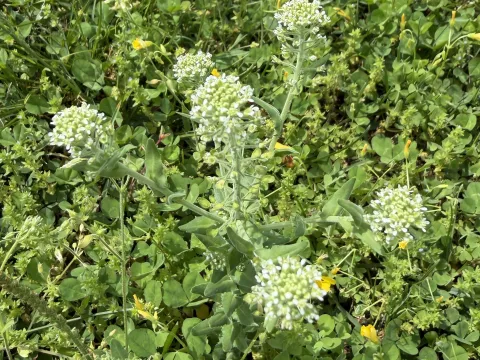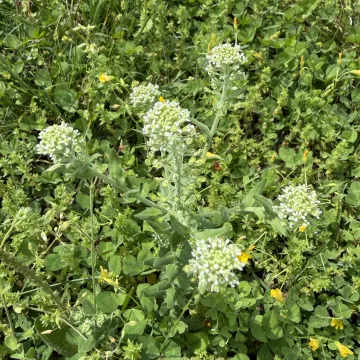
Field pepperweed
Lepidium campestre (L.) R. Br.
Description
Field pepperweed (Lepidium campestre) is an annual or biennial herbaceous plant belonging to the Brassicaceae family. While traditionally categorized as an agricultural weed, it is gaining interest as a potential oilseed crop due to the significant oil content present in its seeds, which offers specific chemical properties suitable for industrial applications.
The plant is native to Europe and Western Asia, but it has naturalized throughout most of the temperate regions of the Northern Hemisphere. Its ability to thrive in disturbed soils and various microclimates has allowed it to occupy diverse habitats, ranging from arable fields and pastures to roadsides and uncultivated wasteland.
Botanically, field pepperweed is characterized by an erect, hairy stem that typically grows to a height of 30 to 60 centimeters. It features simple, alternate leaves, with basal leaves often forming a distinct rosette. The plant produces small, white flowers clustered in terminal racemes, which eventually develop into distinct, pouch-like seed pods containing dark brown seeds.
In terms of cultivation, the plant is noted for its adaptability to a wide range of soil types, though it prefers well-drained loamy soils and sunny exposures. It is highly resistant to cold, making it suitable for early spring sowing or winter cropping. Proper management of field density and weed control during the early stages of development is crucial for achieving high yields.
The economic potential of field pepperweed spans several key sectors:
- Extraction of fatty oils for industrial use in lubricants, detergents, or biofuels.
- Usage of biomass in forage production systems for livestock feeding.
- Implementation as a cover crop to maintain soil structure and improve nutrient cycling in rotation systems.
Crop protection remains a critical aspect of growing field pepperweed. Similar to other Brassicaceae, it is susceptible to flea beetles, cabbage aphids, and various fungal pathogens like downy mildew. Agronomists recommend strict adherence to crop rotation intervals to minimize pest pressure and ensure the long-term health of the field environment.
Photo gallery