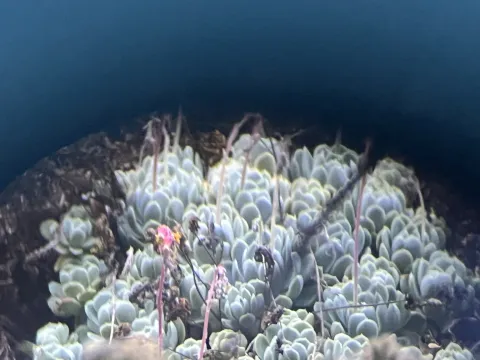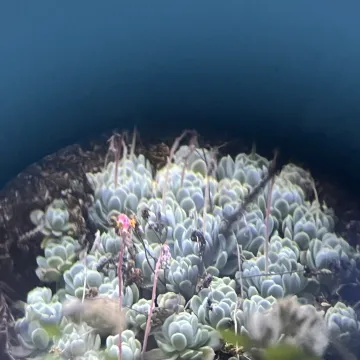
Mexican snowball
Echeveria elegans Rose
Description
Mexican snowball, scientifically known as Echeveria elegans, is a perennial succulent plant belonging to the Crassulaceae family. It is widely recognized for its geometric, rose-like leaf arrangement and is a staple in ornamental horticulture and xeriscaping.
The plant originates from the semi-desert regions of Mexico, where it thrives in rocky terrain and well-drained volcanic soil. This origin dictates its resilience to high-temperature environments and low water availability, making it a classic example of xerophytic adaptation in succulent flora.
Botanically, the species is characterized by its pale, bluish-green, fleshy leaves arranged in tight, spiraling rosettes. The leaves are typically coated with a fine, powdery wax bloom (epicuticular wax), which helps the plant conserve internal moisture and reflects intense solar radiation to prevent leaf damage.
Agrotechnical requirements for Echeveria elegans focus on mimicking its natural habitat. It requires a highly porous, gritty substrate that ensures rapid drainage. During the growing season, deep but infrequent watering is recommended, while in the dormant winter phase, moisture must be severely restricted to prevent root rot.
- Requires 6–8 hours of bright, indirect light daily.
- Thrives in temperatures between 18°C and 25°C during active growth.
- Best propagated via leaf cuttings or offsets (pups).
Common issues include mealybugs, which hide between the tight leaf clusters, and fungal pathogens caused by excessive humidity. Growers should prioritize air circulation and dry surface conditions to maintain plant health and prevent the common collapse of the root system due to overwatering.
Photo gallery