
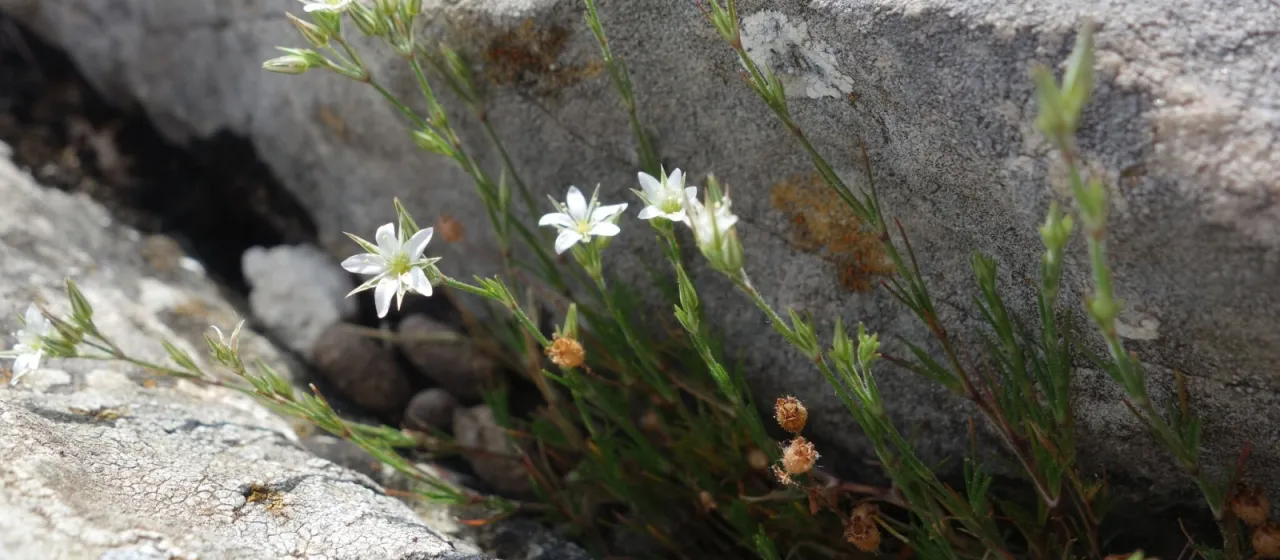
Description
Minuartia mutabilis is a perennial herbaceous plant belonging to the Caryophyllaceae family. In an agronomic context, it is categorized as a low-maintenance groundcover or ornamental crop, valued primarily for its exceptional hardiness and its ability to thrive in poor, rocky substrates where other crops fail to establish.
The native range of this species is primarily located in the mountain regions and stony landscapes of Europe. Its evolutionary adaptation to harsh environments makes it highly resistant to drought and low nutrient availability. These characteristics are essential for agronomists when planning the utilization of this plant in landscape stabilization or xeriscaping projects.
Botanically, the plant forms dense, mat-like cushions composed of narrow, linear foliage. During its flowering cycle, it produces an abundance of small, star-shaped flowers that create a continuous cover. The root system is relatively shallow but efficient, allowing the plant to exploit mineral-rich, well-drained pockets of soil typically found in alpine settings.
Cultivation requirements involve providing full sun exposure and sandy or loamy soils with excellent drainage. Agronomic management is minimal, as the species is well-adapted to surviving without supplemental irrigation or heavy fertilization. Proper soil pH, ranging from neutral to slightly alkaline, is essential for optimal growth and visual density of the plantings.
The primary economic use is in ornamental horticulture and the ecological restoration of dry, exposed slopes. Because of its structural integrity, it serves as an effective soil stabilizer. Typical phytosanitary issues include root rot caused by poor water drainage and occasional infestations of aphids or spider mites, which require standard monitoring during the early stages of the growing season.