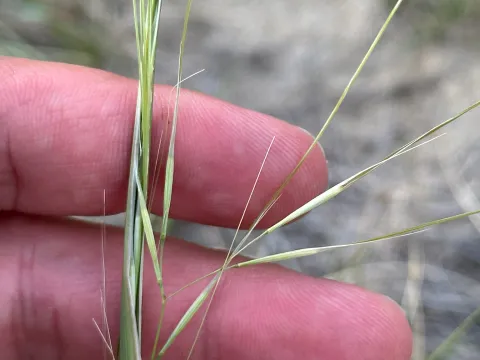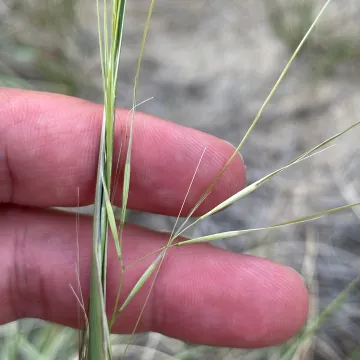
Needle-and-thread grass
Stipa comata Trin. & Rupr.
Description
Needle-and-thread grass (Stipa comata Trin. & Rupr.) is a perennial bunchgrass belonging to the Poaceae family. Recognized for its significant ecological role, it is a key species in the rangelands of North America, serving as a primary component of the vegetation in semi-arid environments.
The native distribution area of this species encompasses the Great Plains and adjacent regions, where it thrives in sandy, well-drained soils. Its ability to tolerate low-nutrient substrates and prolonged droughts makes it a valuable candidate for land restoration projects and conservation agriculture.
Botanically, Stipa comata is characterized by narrow, rolled leaves and distinct, feathery awns that extend from the seeds. These awns exhibit a unique mechanical adaptation: they coil and uncoil with changes in humidity, physically drilling the seed into the soil profile to ensure successful germination.
From an agricultural management perspective, this grass is prized for early-season forage when its nutritional quality is highest. However, farmers must exercise caution as the sharp callused bases and stiff awns of the seeds can cause mechanical injury to the eyes and mouths of grazing livestock during late summer.
Management strategies focus on maintaining optimal stocking rates to prevent overgrazing. While the plant is inherently resilient, it can be susceptible to various leaf spot diseases under conditions of poor ventilation or excessive moisture, and insect pressure remains a factor in seed production areas.
Photo gallery