


SKU #3259
·
326 views
Alyonushka
Apple
User rating
0 votes0% positive reviews
No ratings yet — be the first.
Type of Sort
Summer apple variety
Tree; Growth Power
Slightly Undergrown
Tree; Canopy Shape
Broad canopy
Fruit; Fruit Shape
Round
Prices in stores
from2 350 €per 1000 pcs
2 offers from 2 stores
About product

A summer variety developed at the Krasnoyarsk Experimental Fruit Station by N. N. Tikhonov and A. S. Tolmacheva from crossing the early variety Lalietino with Papirovka. Since the 1960s and up to the present, this variety has held a leading position in the production of planting material at the station. The most widely grown and beloved variety among Siberian gardeners. Included in the State Reg…
Type of Sort
Summer apple variety
Tree; Growth Power
Slightly Undergrown
Tree; Canopy Shape
Broad canopy
Fruit; Fruit Shape
Round
Description
A summer variety developed at the Krasnoyarsk Experimental Fruit Station by N. N. Tikhonov and A. S. Tolmacheva from crossing the early variety Lalietino with Papirovka.
Since the 1960s and up to the present, this variety has held a leading position in the production of planting material at the station. The most widely grown and beloved variety among Siberian gardeners. Included in the State Register for Krasnoyarsk Krai, Chita, Irkutsk, Tomsk, Tyumen, Novosibirsk, Kemerovo regions, Buryatia, Tuva, Khakassia. In terms of fruit quality, winter hardiness, and yield, it is the best variety in the forest-steppe zone of Krasnoyarsk Krai.
The tree is a semi-dwarf, fast-growing, and produces a high number of saplings in the nursery. It enters fruiting early, and growth slows down. The crown has drooping branches, medium density, with strong foliage. The bark is brown, with an olive tint on the shaded side. Fruiting occurs on simple and complex ring branches, fruiting twigs, and occasionally on last year's growth.
Shoots of medium thickness, straight, round in cross-section, flexible, brownish-brown, hairy. Buds are few and small; buds are pressed, round, hairy.
Leaves are medium-sized, egg-shaped, short-tapered, with delicate venation, finely serrated edges, light green with a bluish tint, hairy, matte, on a medium hairy petiole, with small semilunar stipules.
Flowers are large, white, fragrant, buds pink. Petals are egg-shaped, sparsely arranged. Stigma column is medium, weakly hairy. Stigmas are aligned with stamens.
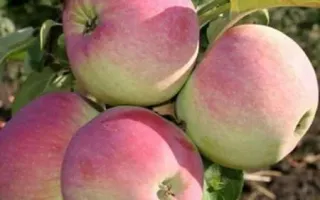
Fruits (see fig.) are small, round, fairly uniform, tapering toward the calyx, weakly ribbed, often with a seam, sometimes flattened. Color when harvested is straw-yellow with a blurred, streaky, pink-red blush covering the entire fruit, becoming more intense during storage. Skin is smooth, waxy, with a slight coating. Peduncle is thin, thickening toward the base, medium length, sometimes short, occasionally slightly swollen in a small shallow cup, without rust; calyx does not drop, closed, in a small, grooved saucer. Subcalyx tube is short, funnel-shaped. Axial cavity is small, seed chambers do not connect.
Fruit flesh is white, medium density, coarse-grained, juicy. Taste is slightly sour-sweet, with a spicy flavor and strong aroma. Chemical composition of fruits: dry matter — 16.6%, sugars — 10.7%, titratable acids — 0.7%, ascorbic acid — 31.2 mg/100g (13.5–42), vitamin P — 196 mg/100g, tannins — 0.12%.
Summer variety, harvest from August 10–15. Fruit storage life is 1–1.5 months. During storage, fruits rot, sometimes soften.
Fruits remain well on the tree. Their transportability is good. Fruit quality of this variety — up to 76%.
Fruits are used fresh, for making compotes, puree, juices, jams.
Self-sterile variety. Best pollinators: Lada, Mana, Youth, Spotlight, Zarница.
Begins fruiting on the 3rd–4th year. Average yield over 13 years: 79 centners per hectare, maximum — 220. In favorable microzones, gardeners obtain up to 80 kg per tree. Fruits regularly bear fruit for 10 years, then intermittently.
Winter hardiness is high. During critical winters of the 1960s and 1980s, the variety survived without loss of crown (cumulative negative average daily temperatures in 1969 — 2926°C, minimum temperature -41.8°C, soil temperature at the end of February -48.4°C). Recovery ability is high. Drought resistance is moderate.
During years of severe epidemics, fruits are moderately affected by scab, leaves — severely.
Advantages of the variety: high winter hardiness, early fruiting, high yield, small tree size, universal use, early fruit utilization, high vitamin content.
Disadvantages of the variety: insufficient resistance to scab during severe epidemics, small fruit size, insufficient storage life.
Crop & resistance
Crop
Specifications hover over for a hint about the specification
| Type of Sort | |
|---|---|
| Tree; Growth Power | |
| Tree; Canopy Shape | |
| Fruit; Fruit Shape | |
|
Fruit; flesh color
Fruit; flesh color
Color of the fruit flesh. There are red, pink, yellow, and brown colors. |
|
| Fruit; Fruit Color (Base Color) | |
| Fruit; Blush (Blush Color) | |
| Fruit; Lying | 1-1.5 |
| Cold Resistance | |
| Catalog | Catalog → Apple |
Store offers · 2 from 2 stores
Prices are updated on loadLoading offers…
Aggregator catalog: prices are collected automatically from store websites, normalized by AI and converted at the current exchange rate. Before ordering, confirm the price and availability on the store's website. This block is not indexed by search engines — the data is loaded after the page opens.
Alternatives
Apple · similar varieties


See also
Often considered together with this variety






TIKHOMIROV REMEMBER APPLE
BOTANIChESKIJ SAD MGU IM.M.V.LOMONOSOVA
035 22 offers
4 457 €за 1000 шт ≈ 227 572 ₴
Recently viewed
Similar items in this catalog section


Comments · 0