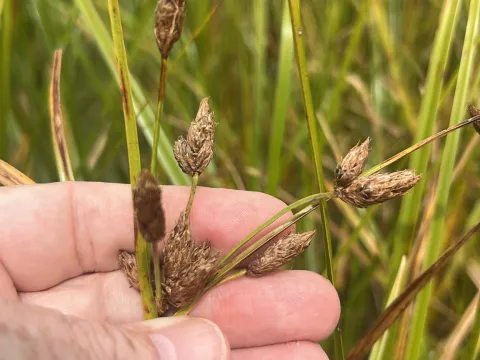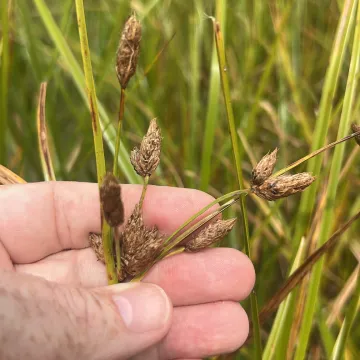

River bulrush
Bolboschoenus fluviatilis
Description
River bulrush (Bolboschoenus fluviatilis) is a perennial herbaceous plant belonging to the Cyperaceae family. It is a robust, moisture-loving species that thrives in aquatic and semi-aquatic environments, characterized by its distinctive underground stolons tipped with tubers, which store energy for rapid growth and spread.
The native distribution of this plant spans across various temperate and subtropical regions of North America and Eurasia. In agricultural practices, it is increasingly recognized for its role in wetland restoration, biomass production on marginal water-saturated lands, and its unique ability to thrive where traditional crops would fail.
Botanically, the plant features a triangular stem that can reach heights of up to 1.5 meters. The reproductive strategy is both vegetative, through the expansion of its rhizome system, and sexual, through the production of wind-pollinated spikelets. These features make it a highly competitive species in its native habitat.
Cultivation requirements focus heavily on hydration and soil type. River bulrush performs best in rich, silty, or loamy soils that remain constantly saturated or submerged. While it is tolerant of fluctuating water levels, optimal growth is achieved in sunny locations with high nutrient availability in the substrate, essential for maximizing seasonal biomass yield.
Economically, it serves as an excellent natural filter for water purification, a stabilizer for riparian zones to prevent soil erosion, and can be used as a supplementary forage for wetland-dependent wildlife. Management of the crop requires monitoring for pathogens like stem rot fungi or insect pests such as stem-boring larvae that can negatively impact crop density if left unchecked.
Photo gallery